TL;DR:
- UK visa rules have become stricter, with higher salary thresholds and sponsorship requirements for Turkish applicants.
- Preparing tailored applications with UK-standard documents and targeted strategies increases chances of securing sponsorship.
- Focusing on shortage occupation sectors or the global talent route offers more effective pathways around sponsorship challenges.
Finding a job in the UK as a Turkish national is genuinely harder than it used to be. Salary thresholds have risen, sponsorship rules have tightened, and many employers remain cautious about hiring from outside the UK. Whether you are planning to relocate for work, study, or to reunite with family, understanding the current landscape is the first step. This guide walks you through every stage, from choosing the right visa route to identifying legitimate sponsors and preparing a strong application. The goal is simple: give you a clear, honest picture of what it takes to secure employment in the UK in 2026.
Table of Contents
- Understanding UK job and visa requirements
- Preparing your application: Skills, documents, and strategies
- Finding and applying for jobs: Step-by-step
- Navigating family reunification and dependants rules
- A fresh perspective: Why rule changes demand a smarter job strategy
- Connect with expert support for your UK job journey
- Frequently asked questions
Key Takeaways
| Point | Details |
|---|---|
| Visa type matters | Choosing the right UK visa route greatly influences your job search and eligibility. |
| Sponsorship challenges | Job sponsors are increasingly selective due to recent policy changes and increased salary requirements. |
| Family rules impact | New limits on dependants and higher salary thresholds affect settlement plans for Turkish applicants. |
| Preparation is critical | Properly preparing documents and researching sponsor credibility increases your success rate. |
| Expert support helps | Personalised recruitment and visa services can simplify the complex UK job search process. |
Understanding UK job and visa requirements
Before you search for a single job listing, you need to understand the legal framework that governs your right to work in the UK. Turkish nationals do not have automatic rights to work in the UK following Brexit, which means a valid visa is essential for almost every employment scenario.
The main routes available to Turkish applicants include:
- Skilled Worker Visa: For roles on the eligible occupations list with a licensed sponsor
- Health and Care Worker Visa: A faster, cheaper route for medical and care professionals
- Student Visa: Allows part-time work during studies and a pathway to graduate employment
- Global Talent Visa: For recognised leaders in science, arts, engineering, or academia
- Family Visa: For those joining a settled partner or spouse already living in the UK
You can explore the full range of UK visa types to identify which route best fits your situation before committing to any application.
One of the most significant legal obstacles is the sponsor requirement. Employers must hold a valid sponsorship licence issued by the Home Office before they can hire you. Many smaller businesses do not hold this licence, which immediately narrows your job search. Furthermore, salary thresholds for the Skilled Worker route increased significantly in 2024 and remain high in 2026, making lower-paid roles ineligible for sponsorship.
Family reunification is also a major pathway. Over 67,000 family visas were issued in 2025, with most applicants on a path towards indefinite leave to remain (ILR). However, this route comes with its own financial requirements and restrictions.
| Visa route | Minimum salary (2026) | Sponsor required? | Settlement pathway |
|---|---|---|---|
| Skilled Worker | £38,700 (general) | Yes | Yes (after 5 years) |
| Health and Care Worker | Role-dependent | Yes | Yes |
| Student Visa | N/A | Yes (university) | Via Graduate Visa |
| Global Talent | None | No | Yes |
| Family Visa | £29,000 (sponsor income) | No | Yes |
For a practical overview of the job search process itself, the job search guide for foreigners provides useful context alongside the visa requirements.
Preparing your application: Skills, documents, and strategies
With the basic requirements understood, the next step is preparing your credentials and documentation. This is where many applicants lose ground, not because they lack qualifications, but because they underestimate how different UK application standards are from those in Turkey.

Start by assessing your qualifications honestly. UK employers expect degrees and professional certifications to be clearly explained, and in some sectors, overseas qualifications must be formally recognised. For example, doctors require GMC registration, and engineers may need UK NARIC (now ENIC) assessments.
The essential documents you will need include:
- A UK-style CV (typically two pages, no photo, no date of birth)
- A tailored cover letter for each application
- References from previous employers (at least two)
- Copies of educational certificates and transcripts
- Proof of English language proficiency (IELTS or equivalent)
- A Certificate of Sponsorship (CoS) from your employer, once offered a role
Choosing the right visa route matters enormously at this stage. The skilled worker visa salary requirements are a critical factor: if the role you are targeting pays below the threshold, you may need to consider the Global Talent route instead. The UK Global Talent Visa guide explains how endorsement works and which bodies assess applications in different fields.
| Feature | Skilled Worker Visa | Global Talent Visa |
|---|---|---|
| Sponsor required | Yes | No |
| Salary threshold | £38,700+ | None |
| Endorsement needed | No | Yes |
| Processing time | 3 to 8 weeks | 5 to 8 weeks |
| Best for | Employed professionals | High achievers, researchers |
Government data shows that 53% of applicants find the skilled worker application process straightforward, but 15% report significant difficulties. The difference usually comes down to preparation. Applicants who gather all documents before starting the application, and who tailor their CV to UK standards, consistently report smoother experiences.
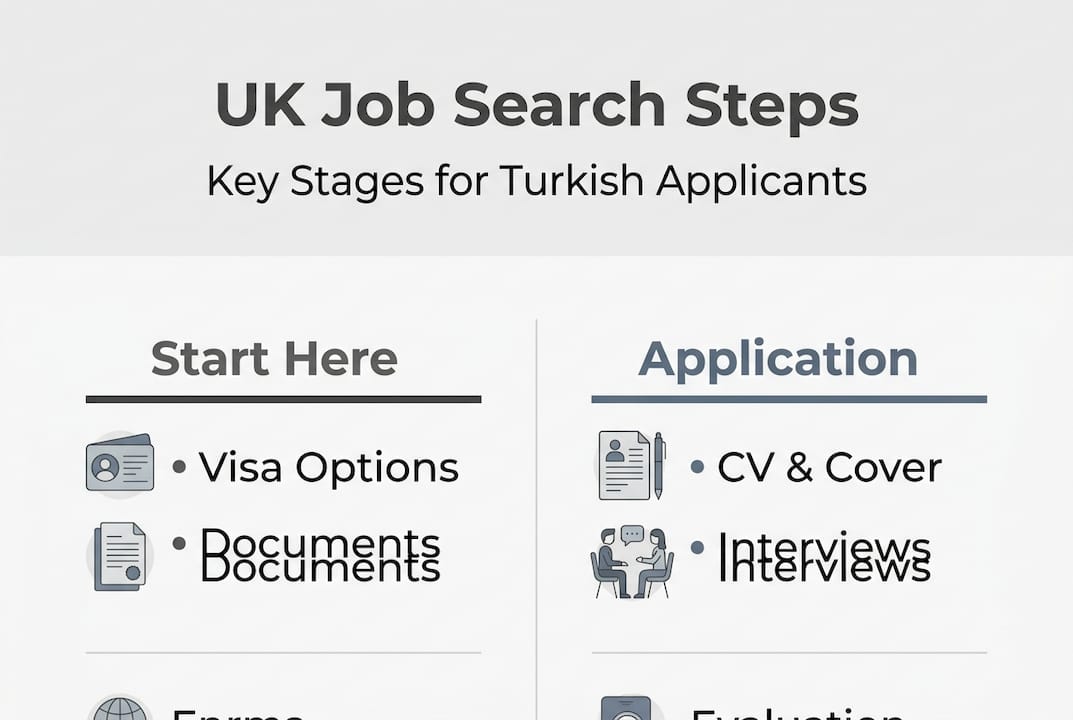
Pro Tip: Never submit a generic CV. UK recruiters spend an average of seven seconds on an initial scan. Lead with your most relevant experience for the specific role, and remove any information that is standard in Turkey but unusual in the UK, such as a photograph or marital status.
Finding and applying for jobs: Step-by-step
Once your documents are in order, you are ready to take practical action in your job hunt. The UK job market is competitive, but it is also structured, and knowing where to look makes a substantial difference.
- Search on the right platforms: Use Indeed UK, Reed, Totaljobs, and LinkedIn. For healthcare roles, NHS Jobs is the primary source. For shortage occupation roles, check the government’s immigration salary list regularly.
- Filter for licensed sponsors: Use the official sponsor register to verify that any employer you apply to holds a valid sponsorship licence. Do not rely on a company’s word alone.
- Tailor every application: Match your skills directly to the job description. Use the same language the employer uses. UK hiring managers notice when applicants copy and paste the same cover letter.
- Contact sponsors directly: If a company is on the sponsor register but has not advertised a role, a polite, professional speculative application can work. Many Turkish professionals have secured interviews this way.
- Track your applications: Use a simple spreadsheet to log every application, the contact name, the date, and the outcome. This helps you follow up professionally and avoid duplicate submissions.
The skilled worker visa guide for Turkish professionals outlines exactly what employers need from you at each stage of the sponsorship process, which helps you prepare better questions for interviews.
One important warning: sponsors are increasingly reluctant to hire unless the role is formally classified as a shortage occupation. This means your chances improve significantly if you target sectors such as healthcare, engineering, IT, and construction.
Scammers frequently target foreign job seekers with fake job offers and fraudulent visa services. Always verify a company’s sponsorship status on the official government register before paying any fees or sharing personal documents.
If you are currently studying in the UK, you may already have a head start. The guide on switching from student to skilled worker visa explains the conditions under which you can change your status without leaving the country.
Pro Tip: Networking is underused by Turkish applicants. Join Turkish professional associations in the UK, attend sector-specific events, and connect with Turkish alumni from UK universities on LinkedIn. A warm introduction still opens more doors than a cold application.
Navigating family reunification and dependants rules
Many applicants must also consider family reunification and changing rules for dependants, which have significant implications on job choices and long-term planning.
In 2025, 67,537 family visas were issued, reflecting strong demand for this route. However, the rules have shifted considerably. The minimum income requirement for a sponsor bringing a partner to the UK rose to £29,000 in 2024 and remains at this level in 2026. This directly affects which jobs are viable if you plan to bring your family.
Key changes affecting Turkish applicants include:
- Higher income thresholds: The sponsoring partner must earn at least £29,000 annually
- Restricted dependants for students: International students can no longer bring dependants unless enrolled in a government-funded research programme
- Longer qualifying periods: Some routes now require a longer period of residence before ILR can be applied for
- Increased financial evidence: Bank statements covering a longer period are now required
These changes mean that your job strategy must account for family plans from the outset, not as an afterthought. A role that meets the Skilled Worker salary threshold but falls below the family visa income requirement puts your family’s reunification at risk.
Important statistic: Over 67,000 family visas were issued in 2025, yet many applicants are unaware that failing to meet the income threshold is the single most common reason for refusal.
For a clear breakdown of UK visa eligibility for Turkish applicants across all categories, including family routes, it is worth reviewing the eligibility criteria before you accept any job offer. The detailed guide on spouse and dependent visa financial requirements is particularly useful if you are planning to bring a partner or children.
Maintaining legal compliance throughout your stay is equally important. Keep your employer informed of any changes to your visa status, renew your leave to remain before it expires, and keep copies of all correspondence with the Home Office.
A fresh perspective: Why rule changes demand a smarter job strategy
Most advice for Turkish job seekers in the UK focuses on the mechanics: find a sponsor, prepare your CV, submit your application. That advice is not wrong, but it misses something important. The rules have changed so significantly in the past two years that strategies which worked in 2022 or 2023 are now far less effective.
The reality is that traditional job hunting, sending applications to any company that looks promising, is increasingly inefficient. With 36% of sponsors actively avoiding overseas hires unless a role is in shortage, you are wasting time applying to companies that will not sponsor you regardless of your qualifications.
The smarter approach is to start with the shortage occupation list and work backwards. Identify roles you are qualified for, then identify licensed sponsors in those sectors, and only then begin tailoring applications. This reversal of the usual process dramatically improves your conversion rate.
Alternatively, if your profile is strong enough, the global talent visa requirements may offer a route that bypasses the sponsorship problem entirely. We see this route underused by Turkish applicants who assume it is only for academics. In practice, it is open to recognised leaders in technology, arts, and digital sectors too.
Flexibility and research are not optional extras. In 2026, they are the foundation of any successful UK job search.
Connect with expert support for your UK job journey
Navigating UK visa rules, salary thresholds, and sponsorship requirements is complex, and getting it wrong is costly. UK Visa Assistance, regulated by the Immigration Advice Authority (IAA) at Level 1, provides expert guidance tailored specifically to Turkish professionals and students.
Whether you are looking for skilled worker jobs for Turkish applicants, exploring self-sponsorship visa advice, or simply need a clear assessment of your options, our team is here to help. Visit metin.london to explore our full range of UK visa recruitment services and speak with an adviser who understands your situation from the ground up.
Frequently asked questions
What are the main visa options for Turkish job seekers in the UK?
Turkish applicants can apply through skilled worker visas, student visas, or family reunification routes depending on their qualifications and circumstances. 67,537 family visas were issued in 2025 alone, making it one of the most used pathways.
How hard is it to secure sponsorship for a UK job?
36% of sponsors actively avoid hiring overseas applicants unless the role is in shortage, though 53% of applicants overall find the process manageable with proper preparation.
What documents are needed for a UK job application?
You will need a UK-style CV in English, at least two references, proof of sponsorship, relevant qualification certificates, and evidence of English language proficiency.
Can family members join me when I work in the UK?
Family members may join via family reunification visas, but new rules limit dependants and require the sponsoring partner to earn at least £29,000 annually.
Are there risks of scams when searching for UK jobs?
Yes, scammers frequently target foreign applicants with fake offers and fraudulent visa services. Always verify a potential employer’s sponsorship status on the official government register before sharing any personal documents or paying fees.