Many Turkish professionals believe the UK Skilled Worker visa requires years of experience or exceptionally high salaries, but this isn’t accurate. The route actually offers accessible pathways for skilled workers across various experience levels, with salary thresholds designed to be achievable whilst protecting the UK labour market. Understanding these requirements properly can transform confusion into a clear application strategy. This guide explains exactly what Turkish professionals need to know about the UK Skilled Worker visa in 2026, from eligibility criteria to salary thresholds and sponsorship processes.
Table of Contents
- What Is The UK Skilled Worker Visa And Who Is Eligible?
- Salary Requirements And Thresholds For 2026
- How To Secure Sponsorship And Meet Visa Application Requirements
- Comparing The Skilled Worker Visa With Other UK Work Visas
- Metin.London UK Visa And Recruitment Services For Skilled Professionals
- Frequently Asked Questions About The UK Skilled Worker Visa
Key takeaways
| Point | Details |
|---|---|
| Sponsorship requirement | You must secure a job offer from a UK employer licensed to sponsor workers |
| General salary threshold | The standard minimum salary is £41,700 annually for most skilled roles in 2026 |
| New entrant rate | Recent graduates and career switchers may qualify at £33,400 per year |
| Eligible occupations | Only jobs listed in the government’s skilled occupations appendix qualify for sponsorship |
| Visa replacement | This route replaced the Tier 2 General visa in December 2020 with updated criteria |
What is the UK skilled worker visa and who is eligible?
The UK Skilled Worker visa enables foreign nationals to work in the United Kingdom in specific skilled occupations. This immigration route allows employers to recruit people to work in the UK in a specific job in an eligible skilled occupation, providing a structured pathway for international talent. The visa requires sponsorship from a UK employer who holds a valid sponsor licence, meaning you cannot apply independently without securing employment first.
This route replaced the Tier 2 General route from 1 December 2020, bringing updated requirements and streamlined processes. The changes aimed to create a more flexible system that responds better to UK labour market needs whilst maintaining standards that protect domestic workers. For Turkish professionals, this means clearer pathways and more transparent criteria compared to previous immigration systems.
Eligibility centres on three core requirements. First, you must have a confirmed job offer from a licensed UK sponsor. Second, your occupation must appear on the list of eligible occupations, which covers roles from healthcare to technology and engineering. Third, you must meet minimum skill and salary thresholds that vary by occupation and experience level.
Key eligibility factors include:
- Valid job offer from a UK employer with sponsor licence
- Role classified at RQF Level 3 or above (equivalent to A-level standard)
- Salary meeting both general and occupation-specific thresholds
- English language proficiency at B1 level on the CEFR scale
- Certificate of Sponsorship with unique reference number
The visa typically grants permission for up to five years, with options to extend and eventually apply for settlement after five years of continuous residence. Your employer sponsors your specific role, so changing jobs requires a new sponsorship unless you meet certain exemptions. Understanding these foundational elements helps Turkish professionals assess their eligibility accurately before investing time and resources into applications.
Salary requirements and thresholds for 2026
Salary thresholds form the financial backbone of Skilled Worker visa eligibility. The UK government sets two salary thresholds: a general threshold and an occupation-specific, hourly rate threshold that work together to determine minimum pay levels. You must meet whichever threshold is higher for your specific role, ensuring fair compensation whilst preventing wage suppression in the UK labour market.
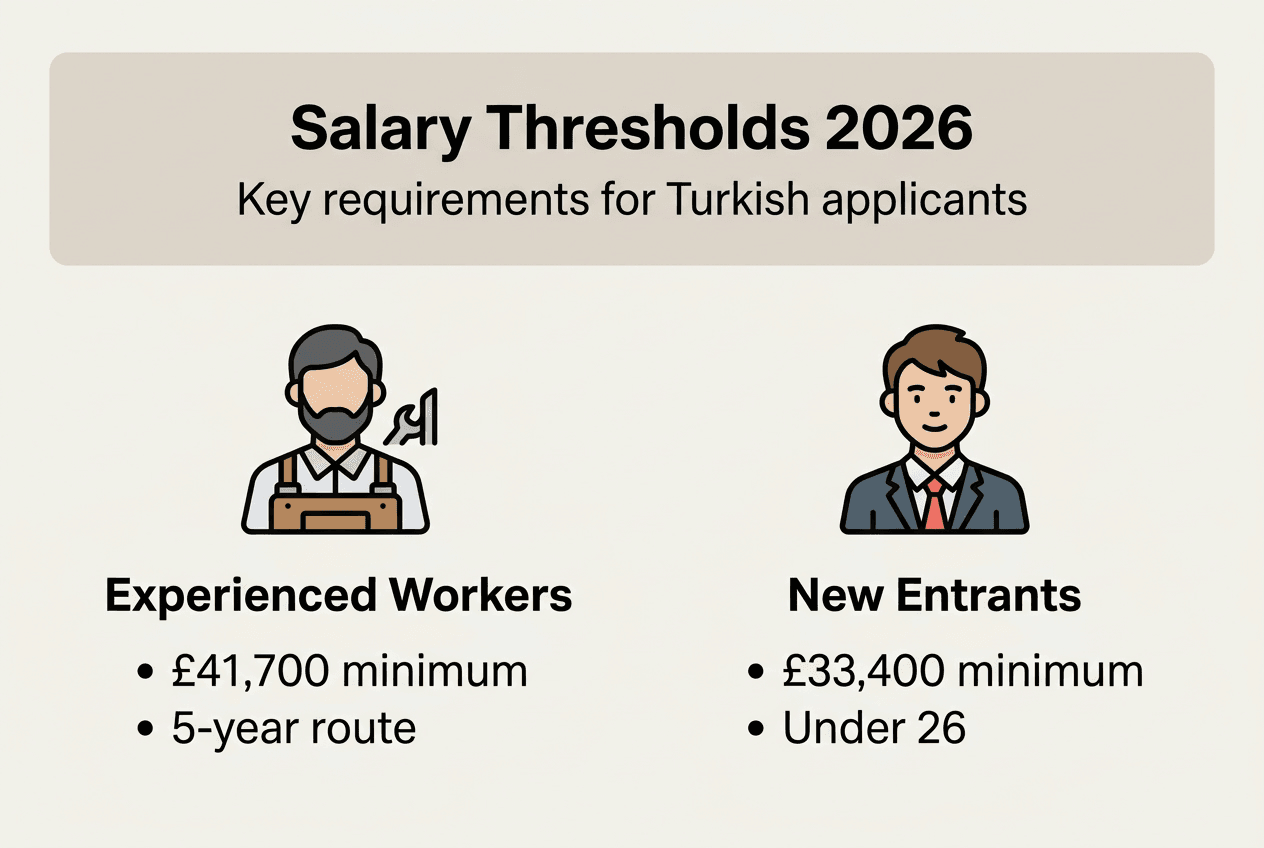
The Migration Advisory Committee recommended maintaining the general threshold at £41,700 for 2026, reflecting median earnings across skilled occupations. This figure represents a careful balance between attracting international talent and protecting opportunities for UK workers. Occupation-specific thresholds vary based on median earnings data for each role, with some positions requiring higher minimums due to market rates.
For new entrants, including recent graduates and career switchers under 26, the MAC recommended a single rate of £33,400 to help typical graduates enter the UK labour market. This reduced threshold recognises that early-career professionals often earn less whilst building experience, making the visa route more accessible without compromising labour market integrity.
| Threshold type | Annual salary | Applicable to |
|---|---|---|
| General threshold | £41,700 | Most experienced skilled workers |
| New entrant rate | £33,400 | Recent graduates, career switchers under 26 |
| Occupation-specific | Varies by role | All applicants based on job classification |
| PhD in relevant field | 90% of standard | Doctorate holders in job-related subjects |
| PhD in STEM field | 80% of standard | Science, technology, engineering, maths doctorates |
These thresholds serve multiple policy objectives. They ensure sponsored workers contribute positively to public finances through tax contributions. They prevent employers from using international recruitment to undercut wages for UK workers. They also prioritise higher-skilled roles where labour shortages exist, aligning immigration with economic needs.
Pro Tip: Calculate your annual salary carefully, including guaranteed bonuses and allowances that form part of your employment package. Some benefits count towards the threshold whilst others don’t, so verify with your employer which components qualify before submitting your application.
Your employer must commit to paying at least the applicable threshold throughout your sponsorship period. The salary requirements for Skilled Worker visa applications undergo regular review, so staying informed about current figures prevents application delays. For Turkish professionals, understanding these thresholds early helps target appropriate job opportunities and negotiate employment terms that meet visa requirements.
How to secure sponsorship and meet visa application requirements
Securing UK employer sponsorship represents the most critical step in your Skilled Worker visa journey. You cannot apply without a Certificate of Sponsorship from a licensed employer, making job search and recruitment your primary focus. The guidance for employers on sponsoring workers outlines what companies must do, but understanding this process helps you position yourself as an attractive candidate.

Your employer must hold a valid sponsor licence and assign you a Certificate of Sponsorship with a unique reference number. This certificate confirms your job details, salary, and eligibility, serving as the foundation of your visa application. Employers face responsibilities including monitoring your employment and reporting changes to the Home Office, so they typically sponsor candidates they’re confident will succeed long-term.
The application process follows these essential steps:
- Secure a job offer from a licensed UK sponsor willing to provide a Certificate of Sponsorship
- Receive your Certificate of Sponsorship reference number and job details from your employer
- Gather supporting documents including passport, English language evidence, and financial proof
- Complete the online visa application form accurately with all required information
- Pay the application fee, immigration health surcharge, and any additional costs
- Attend your biometric appointment at a visa application centre
- Submit all supporting documents and await the Home Office decision
Common pitfalls derail applications despite strong qualifications. Incomplete documentation causes delays or refusals, so compile everything before starting. Misunderstanding sponsorship terms leads to accepting job offers that don’t meet visa criteria, wasting time and money. Underestimating processing times creates problems if you need to start work by specific dates.
Pro Tip: Start finding a sponsor in the UK early by targeting companies already licensed to sponsor workers. The register of licensed sponsors is publicly available, helping you focus applications on employers who can legally sponsor you rather than companies unfamiliar with the process.
English language proficiency requires evidence through approved tests or qualifications. You must demonstrate at least B1 level ability unless you’re from a majority English-speaking country or hold a degree taught in English. Financial requirements ask you to show you can support yourself, though your sponsor can certify maintenance instead of you providing bank statements.
For those already in the UK, switching to Skilled Worker visa from student or other routes offers pathways without leaving the country. Switching applications follow similar requirements but allow you to remain in the UK during processing, maintaining continuity in your life and career plans.
Comparing the skilled worker visa with other UK work visas
The UK offers multiple work visa routes, each designed for different circumstances and qualifications. Understanding how the Skilled Worker visa compares helps you choose the most suitable pathway for your situation. The Skilled Worker route replaced Tier 2 with updated criteria, but other options exist for specific professional profiles.
The Global Talent visa targets individuals with exceptional talent or promise in specific fields including science, engineering, humanities, medicine, digital technology, and arts. Unlike the Skilled Worker route, it doesn’t require a job offer or employer sponsorship. You apply based on endorsement from a recognised UK body in your field, demonstrating extraordinary ability or potential. This route offers greater flexibility for entrepreneurial activities and switching employers.
Student visa holders represent a significant pool of potential Skilled Worker applicants. If you complete a UK degree, you can switch from student to Skilled Worker visa if you secure appropriate sponsorship. The new entrant salary threshold makes this transition more accessible for recent graduates, though you still need a job offer meeting all other criteria.
| Visa type | Sponsorship required | Salary threshold | Job offer needed | Settlement route |
|---|---|---|---|---|
| Skilled Worker | Yes, from employer | £33,400 to £41,700+ | Yes, specific role | After 5 years |
| Global Talent | No, endorsement-based | None | No | After 3 years |
| Graduate visa | No | None | No | No settlement option |
| Health and Care Worker | Yes, from employer | Lower than standard | Yes, healthcare role | After 5 years |
The Health and Care Worker visa functions as a specialised Skilled Worker route with reduced fees and faster processing for eligible healthcare roles. It offers the same settlement pathway but recognises the critical importance of healthcare professionals to the UK. Turkish doctors, nurses, and care professionals often find this route particularly relevant.
Key differences affecting your choice:
- Skilled Worker requires ongoing employer sponsorship whilst Global Talent offers independence
- Salary thresholds apply strictly to Skilled Worker but not Global Talent applicants
- Settlement timelines vary, with Global Talent offering faster permanent residence
- Application costs differ significantly, with Global Talent having higher initial fees
- Job flexibility differs, as Skilled Worker ties you to your sponsoring employer
Choosing the right visa depends on your qualifications, career stage, and long-term goals. Exceptional talents in technology or academia might pursue Global Talent visa requirements for greater flexibility. Most Turkish professionals find the Skilled Worker route more accessible, offering clear criteria and employer support throughout the process.
The guidance for employers on sponsoring workers demonstrates the structured nature of the Skilled Worker route. This structure provides certainty and clear expectations, though it limits flexibility compared to talent-based routes. Evaluating your circumstances honestly helps identify which pathway aligns best with your professional profile and immigration objectives.
Metin.London UK visa and recruitment services for skilled professionals
Navigating UK immigration requirements becomes significantly easier with expert guidance tailored to Turkish professionals. At Metin.London, we specialise in helping skilled workers understand and successfully apply for UK work visas, combining immigration expertise with recruitment support. Our regulated advisors provide comprehensive assistance throughout your visa journey, from initial eligibility assessment to final application submission.
Our services address the specific challenges Turkish professionals face when pursuing UK employment opportunities. We offer detailed guidance on meeting Skilled Worker visa requirements, connecting you with licensed sponsors, and preparing applications that meet Home Office standards. For those interested in entrepreneurial pathways, our self-sponsorship visa guide explains how to establish a UK company and sponsor yourself.
We maintain updated listings of Skilled Worker jobs for Turkish applicants across healthcare, technology, engineering, and hospitality sectors. This recruitment support connects you directly with employers ready to sponsor qualified candidates, streamlining your job search and visa process simultaneously. Our approach combines immigration knowledge with practical employment assistance, addressing both elements of your UK move efficiently.
Frequently asked questions about the UK skilled worker visa
How long does the Skilled Worker visa application take to process in 2026?
Standard processing takes approximately three weeks from your biometric appointment for applications made outside the UK. Priority and super priority services offer faster decisions for additional fees, with some applications decided within days. Processing times vary by location and application volume, so apply well before your intended start date.
Can I switch employers whilst holding a Skilled Worker visa?
Yes, but you need a new Certificate of Sponsorship from your new employer and must apply to update your visa. The new role must still meet Skilled Worker requirements including salary thresholds and skill level. You cannot start the new job until the Home Office approves your updated visa, so plan transitions carefully.
What happens if my salary falls below the threshold after approval?
Your employer must inform the Home Office of significant changes to your employment terms. If your salary drops below the required threshold without valid reason, this could affect your visa status and future applications. Temporary reductions due to circumstances like parental leave have specific provisions, so understand the rules before accepting salary changes.
Do I need to leave the UK to apply for a Skilled Worker visa?
Not if you’re already in the UK on a valid visa that allows switching, such as a student visa or certain work visas. You can apply to switch from within the UK, remaining in the country during processing. If you’re outside the UK or on a visa that doesn’t permit switching, you must apply from your home country.
What documents do I need for a Skilled Worker visa application?
Essential documents include your valid passport, Certificate of Sponsorship reference number, English language test results or qualification certificates, tuberculosis test results if required, and proof of financial maintenance. Your specific circumstances may require additional evidence, so review the Skilled Worker visa guide for comprehensive document checklists.
Can my family members join me on a Skilled Worker visa?
Yes, your partner and children under 18 can apply as your dependants. They must apply separately and pay their own fees and health surcharges. Dependants can work and study in the UK without restrictions, making this route family-friendly for those relocating long-term.