This guide answers the question: what is uk skilled worker pathway, and provides insights into the UK Skilled Worker Visa.
The UK Skilled Worker Visa offers Turkish professionals genuine pathways to employment and settlement in Britain, yet many assume a job offer alone guarantees approval. Success demands meeting strict sponsorship, salary, and skill requirements within a points-based system designed to protect UK labour standards. This guide clarifies eligibility criteria, application steps, family rights, and common misconceptions to help you navigate the process confidently.
Table of Contents
- Eligibility And Qualification Criteria
- Understanding The Sponsorship System
- Application Process And Documentation
- Family Members And Visa Duration
- Common Misconceptions About The Skilled Worker Visa
- How UK Visa Assistance Supports Turkish Professionals
- Frequently Asked Questions
Key takeaways
| Point | Details |
|---|---|
| Visa requirements | Licensed employer sponsorship, salary minimum £26,200 yearly, and occupation at RQF level 3 or above required |
| Application process | Submit online with Certificate of Sponsorship, pay fees £610-£1,408 plus £624 yearly health surcharge, attend biometrics |
| Family inclusion | Spouse, partner, and children under 18 join with full work and study rights in UK |
| Visa duration | Initially granted up to 5 years, extendable, with settlement eligibility after 5 continuous years |
| Common myths | Job offers do not guarantee visas; only Home Office licensed sponsors can employ visa holders |
Introduction to the UK skilled worker visa
The UK Skilled Worker Visa replaced the Tier 2 (General) work visa as part of the UK’s new points-based immigration system effective December 2020. This fundamental shift reflects Britain’s strategic approach to managing labour shortages whilst maintaining control over immigration flows post-Brexit. For Turkish professionals seeking employment opportunities in the UK, understanding this framework proves essential.
The visa operates as the primary route for skilled international workers to fill positions UK employers cannot fill domestically. It assigns points based on job offer quality, salary levels, English proficiency, and occupation type. You need 70 points minimum to qualify, with mandatory points from having a licensed sponsor job offer and meeting skill requirements.
This points-based structure prioritises genuine labour market needs over arbitrary caps. Turkish applicants benefit from transparent criteria that reward qualifications and experience rather than nationality. The system explicitly targets skilled roles in sectors experiencing worker shortages, from healthcare to technology.
The Skilled Worker Visa represents the UK’s commitment to attracting global talent whilst ensuring fair wages and working conditions for all employees.
Understanding UK Skilled Worker Visa salary requirements helps Turkish professionals assess their eligibility before investing time and resources in applications. The framework balances employer needs with worker protections, creating opportunities for those who meet clearly defined standards.
Eligibility and qualification criteria
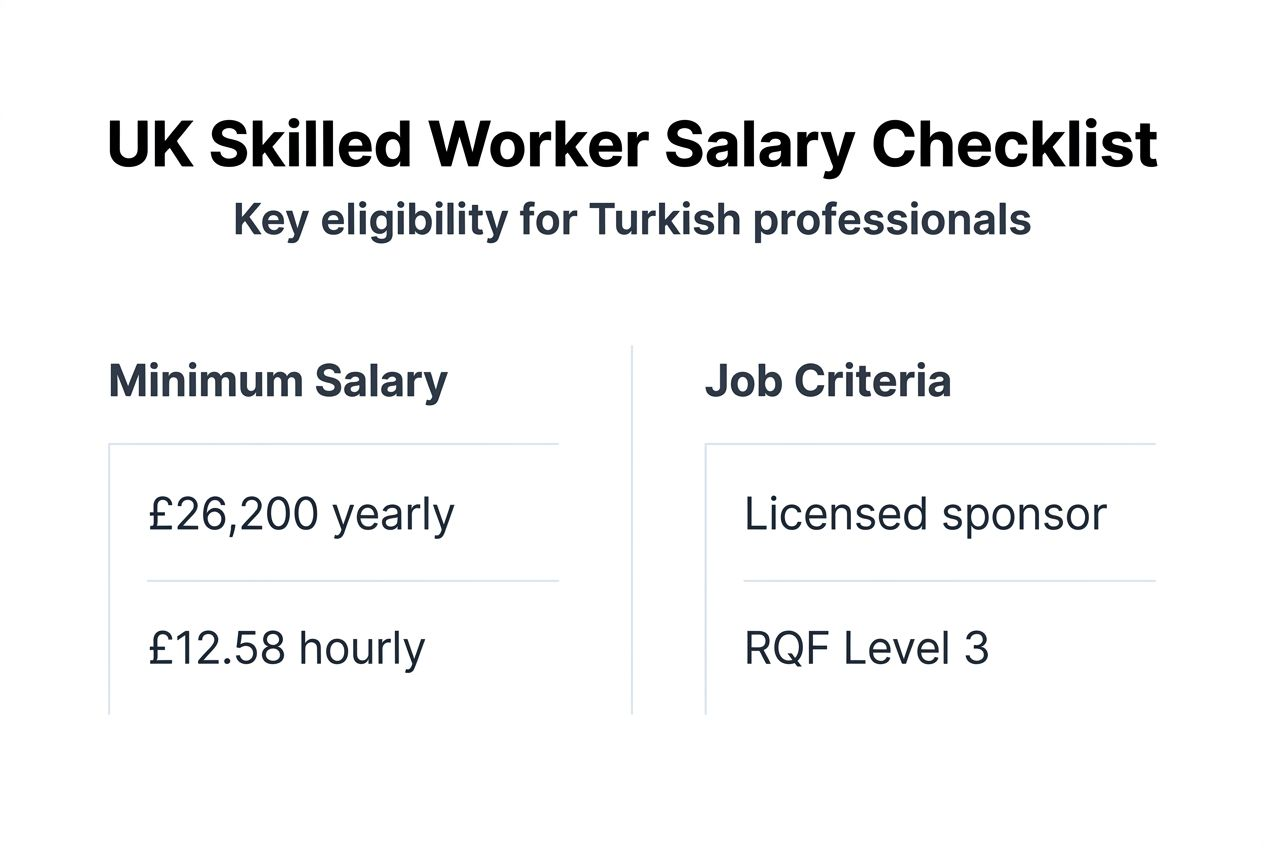
Securing a Skilled Worker Visa demands satisfying multiple interconnected requirements that Turkish professionals must address simultaneously. The foundation starts with a job offer from a UK employer who is a licensed sponsor, without which no application proceeds. This sponsorship certificate proves your employer holds Home Office authorisation and your role meets specific standards.
Your occupation must align with Standard Occupational Classification codes at RQF level 3 or higher, covering roles from healthcare practitioners to IT specialists. These skill thresholds ensure the visa targets genuinely skilled positions rather than entry-level work. Turkish applicants should verify their job titles match approved codes before accepting offers.
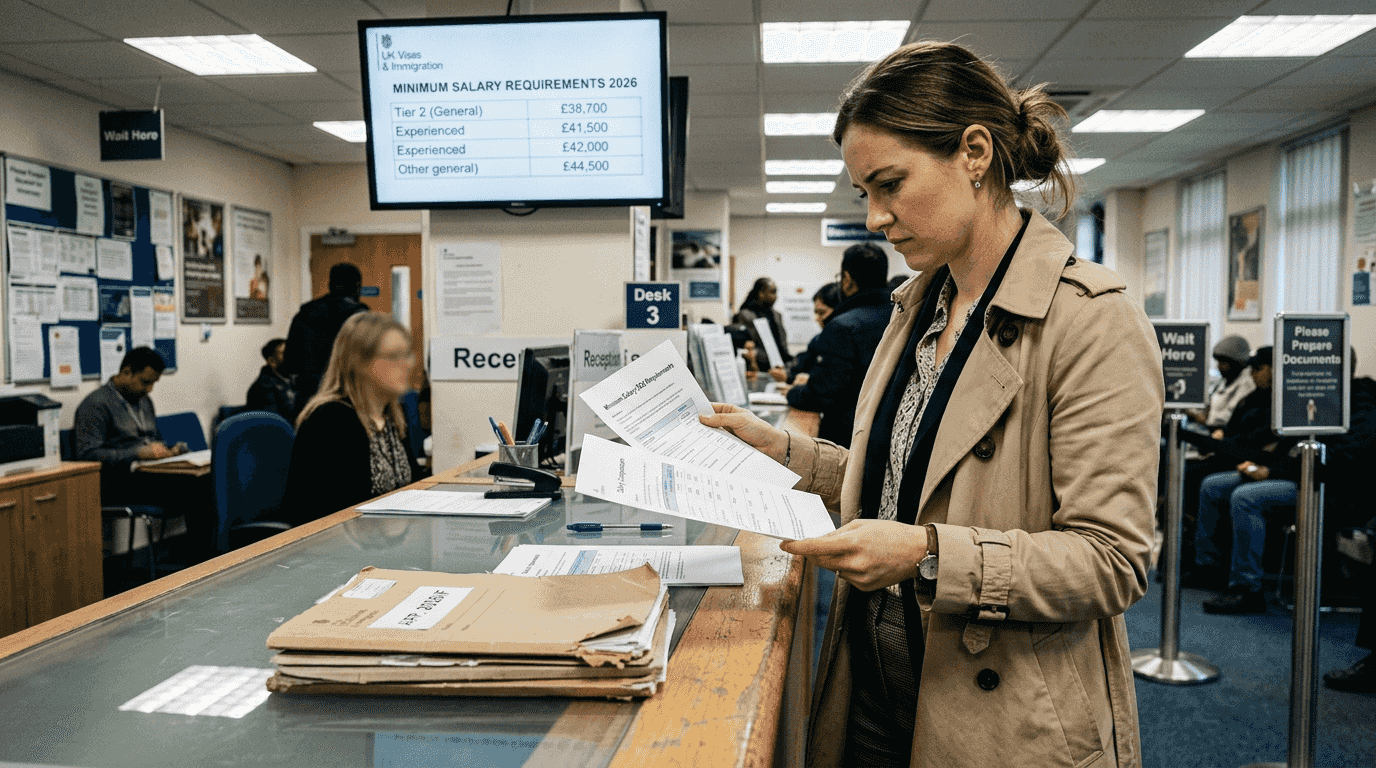
Salary requirements present the most tangible hurdle. The minimum salary threshold to qualify for most Skilled Worker jobs is £26,200 per year or £10.75 per hour, with exceptions for new entrants and some shortage occupations. Your actual salary must meet both the general threshold and the going rate for your specific occupation, whichever proves higher.
| Applicant category | Minimum annual salary | Hourly rate equivalent | Additional notes |
|---|---|---|---|
| Standard applicants | £26,200 | £10.75 | Must also meet occupation going rate |
| New entrants | £20,960 | £10.75 | Available to under 26s or recent graduates |
| Shortage occupations | £20,960 | £10.75 | Specific roles on official shortage list |
| PhD in relevant field | £23,580 | £10.75 | 10% salary discount for STEM PhD holders |
English language proficiency stands as another non-negotiable requirement. You must prove competence at CEFR level B1 in reading, writing, speaking, and listening through approved tests or academic qualifications taught in English. Turkish nationals typically satisfy this through IELTS, PTE Academic, or equivalent recognised examinations.
Pro Tip: Research skilled worker jobs for Turkish applicants targeting shortage occupation roles, which offer lower salary thresholds and faster processing, maximising your approval chances.
Maintenance funds represent the final eligibility component, though sponsorship often covers this. You need £1,270 available for 28 consecutive days before applying unless your sponsor certifies maintenance. This requirement ensures you can support yourself initially without public funds.
Understanding the sponsorship system
The sponsorship framework underpins the entire Skilled Worker Visa process, yet many Turkish professionals misunderstand its mechanics and implications. Only licensed sponsors can employ Skilled Worker visa holders; employers must maintain compliance with Home Office duties. This licensing system protects workers and the UK labour market from exploitation whilst ensuring employers meet rigorous standards.
Obtaining a sponsor licence requires UK employers to demonstrate genuine need, robust HR systems, and commitment to compliance monitoring. Licensed sponsors face ongoing obligations including:
- Reporting employee absences, changes in job duties, or salary reductions within specified timeframes
- Maintaining accurate records of sponsored employees’ right to work documentation
- Cooperating with Home Office compliance visits and audits without advance notice
- Ensuring sponsored roles remain at appropriate skill and salary levels throughout employment
The Certificate of Sponsorship (CoS) your employer issues serves as digital confirmation of your job details, salary, occupation code, and sponsor licence number. This certificate contains unique reference numbers you must include in your visa application. Without a valid CoS, your application fails immediately regardless of other qualifications.
Sponsorship carries costs and administrative burdens for employers, influencing their willingness to hire international workers. Small businesses may hesitate due to licence fees (£536-£1,476) and CoS charges (£199 per certificate), though larger organisations typically absorb these as recruitment costs. Understanding these dynamics helps Turkish applicants target receptive employers.
Pro Tip: Before accepting any UK job offer, verify your prospective employer’s current sponsorship licence status through the Home Office register of licensed sponsors to avoid application failures from unlicensed employers making false promises.
Sponsors risk licence revocation for compliance failures, creating incentives for proper management of sponsored workers. This system’s integrity means Turkish professionals benefit from legitimate employment relationships with documented salaries and conditions. The framework protects your rights whilst enabling employers to access global talent efficiently when domestic recruitment proves insufficient.
Application process and documentation
Navigating the Skilled Worker Visa application demands meticulous preparation and strict adherence to procedural requirements Turkish applicants must follow. The application process requires gathering biometric information, submitting an online application form, and providing a certificate of sponsorship from the employer. Understanding each step prevents costly delays or refusals.
Follow these sequential steps for successful applications:
- Secure your Certificate of Sponsorship from your licensed UK employer containing job details and unique reference number
- Complete the online visa application form on the UK government website, providing accurate personal and employment information
- Pay the visa application fee and Immigration Health Surcharge in full during the online submission process
- Book and attend a biometric appointment at your nearest visa application centre to submit fingerprints and photographs
- Submit supporting documents either online or at your biometric appointment depending on your location
- Await decision, typically within 3 weeks for applications from outside the UK
Your documentation package must include these essential items:
- Valid passport or travel document with blank pages for visa vignette
- Certificate of Sponsorship reference number from your licensed employer
- Proof of English language ability through approved test results or qualifying degrees
- Bank statements showing maintenance funds if your sponsor does not certify maintenance
- Tuberculosis test results if applying from countries where this requirement applies
- Criminal record certificates for certain occupations involving vulnerable groups
Financial preparation proves crucial given substantial costs. Costs include application fees from £610 to £1,408 plus Immigration Health Surcharge of £624 annually. Fees vary based on application location, job circumstances, and visa duration. Turkish applicants should budget for these expenses plus potential legal fees if using immigration advisers.
Processing times generally span three weeks for applications submitted from outside the UK, though complex cases may take longer. Priority services expedite decisions for additional fees, useful for Turkish professionals with urgent start dates. Beginning preparations early prevents last-minute complications that jeopardise job offers.
Understanding dependent visa requirements proves essential for Turkish families planning to relocate together, as family applications run parallel to the main applicant’s process. Coordinating these applications ensures families arrive simultaneously rather than managing staggered relocations.
Family members and visa duration
The Skilled Worker Visa extends beyond individual employment to encompass family unity and long-term settlement prospects for Turkish professionals. Dependent family members including spouse or partner and children under 18 can join the main applicant under the Skilled Worker Visa with rights to work and study in the UK. This inclusive approach recognises family stability enhances worker productivity and integration.
Your eligible family members include:
- Spouse or civil partner in legally recognised relationships
- Unmarried partners in relationships lasting 2+ years with evidence of cohabitation
- Children under 18 at application time, including adopted children and those under sole responsibility
- Children over 18 already in UK as your dependants continuing that status
Dependants enjoy remarkable flexibility upon arrival. They can work in most occupations without restrictions, start businesses, or pursue education at any level. These rights distinguish the Skilled Worker route from more restrictive visa categories. Turkish families benefit from comprehensive integration opportunities rather than limited dependent status.
The Skilled Worker Visa is initially granted for up to 5 years, with extensions allowed, and leads to eligibility for Indefinite Leave to Remain after 5 years’ continuous residence. Your initial visa duration depends on your Certificate of Sponsorship validity plus 14 days, capped at five years maximum. Planning longer-term residence requires understanding extension and settlement pathways.
Extension applications follow similar processes to initial applications, requiring updated Certificates of Sponsorship and continued employment with licensed sponsors. You can extend repeatedly provided you maintain eligibility and employment. Each extension counts towards your settlement qualifying period.
Settlement through Indefinite Leave to Remain becomes available after five continuous years on the Skilled Worker route. This permanent residence status removes employment restrictions and provides security Turkish families value highly. Requirements include:
- Five years’ continuous residence without extended absences exceeding 180 days yearly
- Continued employment meeting Skilled Worker salary and skill requirements
- Passing Life in the UK test demonstrating cultural and civic knowledge
- Meeting English language requirements at B1 level minimum
Understanding the complete timeline from initial application through settlement helps Turkish professionals make informed career decisions. The pathway offers genuine permanence for those meeting requirements, transforming temporary work authorisation into lasting UK residence for entire families. Learn more about dependent visa UK provisions that protect family rights throughout this journey.
Common misconceptions about the skilled worker visa
Misunderstandings about the Skilled Worker Visa create false expectations and application failures among Turkish professionals seeking UK employment. Addressing these misconceptions directly prevents wasted effort and disappointment. The most pervasive myth suggests any UK employer can sponsor visa holders, yet only employers registered and licensed by the UK Home Office can legally sponsor Skilled Worker Visa applicants.
Many Turkish applicants wrongly believe job offers guarantee visa approval. Visa approval depends on meeting salary, skill, and documentation requirements, not just having a job offer. Your employer’s sponsorship certificate merely enables application submission; approval requires satisfying all eligibility criteria independently. This distinction proves critical for realistic planning.
Common myths Turkish professionals encounter include:
- Any UK job qualifies for sponsorship, ignoring skill level and occupation code requirements that restrict eligible roles
- Salary negotiations can occur after visa approval, when Certificate of Sponsorship commitments become binding legal obligations
- Family members automatically receive visas without separate applications, though they must apply individually with required documentation
- Visa processing guarantees employment start dates, despite variable processing times requiring flexible planning
- Previous UK visit visas improve Skilled Worker applications, though visit history proves irrelevant to work visa assessments
Incomplete documentation causes many preventable refusals among Turkish applicants. Missing biometric appointments, failing to provide valid English test results, or submitting expired documents trigger automatic rejections. Attention to procedural details determines outcomes as much as substantive eligibility.
The UK maintains strict Skilled Worker Visa requirements to ensure genuine labour shortages receive priority whilst protecting worker rights and fair wages across all industries.
Another misconception involves believing UK visa sponsorship myths around guaranteed processing times or approval rates. No application receives guaranteed approval regardless of employer reputation or applicant qualifications. Each case undergoes individual assessment against published criteria.
Understanding these realities helps Turkish professionals approach the Skilled Worker Visa process with appropriate expectations and thorough preparation. Success requires meeting every requirement precisely rather than relying on assumptions or incomplete information that lead to costly mistakes.
How UK Visa Assistance supports Turkish professionals
Navigating UK immigration requirements demands expertise Turkish professionals rarely possess independently, making specialist guidance invaluable for success. UK Visa Assistance brings regulated immigration advice to help you secure Skilled Worker Visas efficiently.
We are regulated by the Immigration Advice Authority (IAA) at Level 1 (Ref No. F202000206), providing expert guidance across comprehensive visa categories including Skilled Worker and Scale-up Visas specifically designed for employment pathways. Our services extend beyond application completion to strategic career planning that maximises your approval chances.
Our team assists Turkish healthcare professionals, chefs, and workers from various sectors in finding employment opportunities with licensed UK sponsors actively seeking international talent. We verify employer credentials, review salary packages against Home Office thresholds, and ensure Certificate of Sponsorship accuracy before applications proceed. This due diligence prevents common pitfalls that derail applications.
Whether you need help understanding salary requirements, coordinating family applications, or planning your settlement pathway, our regulated advisers provide clarity throughout your journey. Contact us to discuss how we can support your UK employment ambitions with professional guidance that transforms immigration complexity into achievable steps.
Frequently asked questions
Can Turkish citizens apply for UK skilled worker visas?
Yes, Turkish citizens can apply provided they meet sponsorship, salary, skill, and English language requirements without nationality restrictions.
How long does skilled worker visa processing take?
Applications from outside the UK typically process within 3 weeks, though complex cases may extend this timeline requiring patience.
What happens if my sponsor loses their licence?
Your visa remains valid for 60 days to find new licensed sponsor employment or you must leave the UK.
Can I switch employers on a skilled worker visa?
Yes, you can switch to new licensed sponsors by applying for visa updates with new Certificates of Sponsorship.
Do skilled worker visa holders pay UK taxes?
Yes, you pay income tax and National Insurance like UK residents, funding public services including the NHS you access.