TL;DR:
- The UK now uses the Immigration Salary List and Temporary Shortage List for skilled visas, replacing the old SOL.
- Turkish-speaking trades workers like mechanics, electricians, and welders can qualify through TSL with lower salary thresholds until December 2026.
- Meeting occupation, sponsorship, English, and salary requirements is crucial; timing and sponsor credibility are key factors.
If you are a Turkish-speaking mechanic, welder, or electrician wondering whether the UK still wants your skills, the answer is yes — but the rules have changed significantly. The old Shortage Occupation List (SOL) no longer exists. In its place, the UK now operates two separate frameworks: the Immigration Salary List (ISL) and the newer Temporary Shortage List (TSL). Understanding the difference between these two lists is not just useful background knowledge; it directly determines whether you qualify, what salary you need to earn, and how long your window of opportunity remains open.
Table of Contents
- What is the skilled worker shortage occupation list in 2026?
- Which trades and professions are included on the list?
- Eligibility and requirements for Turkish-speaking workers
- How salary rates and lists affect your application
- What most guides miss: Navigating skills lists and timing for Turkish professionals
- Unlock expert help for your UK skilled worker journey
- Frequently asked questions
Key Takeaways
| Point | Details |
|---|---|
| New lists replace SOL | ISL and TSL have taken over, offering new routes for skilled workers in 2026. |
| Turkish trades can qualify | Mechanics, welders, and electricians are included, with defined salary bands. |
| Eligibility focuses on skills | English proficiency, sponsor licence, and salary thresholds are key requirements. |
| Salary and timing matter | Apply before TSL expires and check salary bands and London weighting carefully. |
What is the skilled worker shortage occupation list in 2026?
The landscape shifted dramatically when the UK Shortage Occupation List was replaced by the Immigration Salary List on 4 April 2024, with eligible ISL roles now requiring a minimum salary of £33,400 as of 2026. This was a significant departure from the old system, which offered a 20% salary discount for shortage roles. The ISL removed that discount and raised the bar instead.
Then, in a further development, the government introduced the Temporary Shortage List for Skilled Worker visas in July 2025, valid until December 2026. The TSL is specifically designed to cover medium-skilled occupations at RQF levels 3 to 5, which are trade and technical roles that fall below the degree-level threshold typically associated with the Skilled Worker route.
The TSL is a targeted, time-limited response to genuine labour shortages in trades and technical sectors. It is not a permanent fixture, which is why timing matters enormously for applicants.
Here is what you need to understand about how these two lists differ:
- ISL (Immigration Salary List): Covers higher-skilled roles, generally RQF6 and above. Minimum salary £33,400. No percentage discount on going rates.
- TSL (Temporary Shortage List): Covers RQF3-5 trade roles. Lower salary thresholds apply. Valid only until 31 December 2026.
- Both lists exist to help UK employers fill vacancies they cannot fill domestically.
- Neither list grants automatic entry. You still need a licensed sponsor, a Certificate of Sponsorship (CoS), and to meet English language requirements.
For Turkish-speaking professionals, the Skilled Worker Visa rules are the foundation of everything. Understanding them before you apply is not optional — it is essential. A solid starting point is the Skilled Worker Visa explained resource, which walks through the full framework in plain language. There is also a dedicated guide for Turkish professionals that covers how these lists interact with your specific circumstances.
Which trades and professions are included on the list?
This is where things get practical. The TSL is particularly relevant for Turkish-speaking workers because it covers exactly the kinds of trades where Turkish professionals tend to have strong experience and qualifications.
Vehicle technicians, mechanics, and electricians (SOC code 5231) are included on the TSL with a standard salary of £35,500 and a lower rate of £27,900 for qualifying applicants. That lower rate is significant. It means that even if you are entering the UK job market for the first time, you may still meet the threshold.
The MAC Stage 1 report shortlisted 82 RQF3-5 occupations for TSL inclusion based on documented shortages across UK industries. The following trades are among the most relevant for Turkish applicants:
- Welding trades (SOC 5215): Standard rate applies with TSL discount eligibility
- Pipe fitters and metal working fitters (SOC 5216): Included based on infrastructure demand
- Electricians and electrical fitters (SOC 5241): High demand across construction and maintenance
- Vehicle technicians and mechanics (SOC 5231): Covered with both standard and lower salary rates
| Occupation | SOC Code | Standard Salary | Lower Rate |
|---|---|---|---|
| Vehicle technicians and mechanics | 5231 | £35,500 | £27,900 |
| Electricians and electrical fitters | 5241 | £34,000 | £26,700 |
| Welding trades | 5215 | £33,600 | £26,400 |
| Pipe fitters and metal working fitters | 5216 | £34,200 | £26,900 |
The relevant TSL occupations also include roles in heating, ventilation, and plumbing, which broadens the opportunity for workers with multi-trade experience.

Pro Tip: If your trade spans more than one SOC code, your sponsor can assign the code that best fits your primary duties. This can make a meaningful difference to which salary threshold applies to your role.
For a fuller picture of UK jobs for Turkish applicants and how to match your skills to open vacancies, it is worth reviewing the visa salary requirements before you start your job search.
Eligibility and requirements for Turkish-speaking workers
Let us be direct: there are no special preferences or disadvantages for Turkish-speaking applicants. The eligibility criteria are the same for everyone. What matters is your occupation, your qualifications, your English level, and whether a licensed UK employer is willing to sponsor you.
Here is the step-by-step process for Turkish-speaking trades workers:
- Secure a job offer from a UK employer who holds a valid sponsor licence. Without this, nothing else is possible.
- Obtain a Certificate of Sponsorship (CoS) from your employer. This is the document that triggers your visa application.
- Meet the English language requirement at B1 level or above. This can be demonstrated through an approved test such as IELTS, or through a degree taught in English.
- Meet the salary threshold for your specific role. For TSL trades, this means at least £27,900 (lower rate) or £35,500 (standard rate) depending on your situation.
- Gather supporting documents including proof of qualifications, identity documents, and financial evidence.
- Submit your visa application online, pay the Immigration Health Surcharge, and attend a biometric appointment.
The Skilled Worker Visa eligibility criteria confirm that mechanics roles with sponsorship are currently advertised at £35,000 to £45,000, which means many genuine job offers already meet or exceed the threshold. New entrant rates may apply if you are under 26, switching from a student visa, or working in a post-doctoral role, but for most trades workers, the standard rate is the relevant benchmark.
Pro Tip: Use the find a UK sponsor resource to identify employers who are already registered to sponsor overseas workers. Approaching pre-approved sponsors saves weeks of back-and-forth.
The Skilled Worker visa guide for Turkish professionals also covers how to present your overseas qualifications in a way that UK employers and the Home Office will recognise.
How salary rates and lists affect your application
Salary is not just a number on your contract. In the Skilled Worker system, it is a points-based signal that determines whether your application succeeds or fails.
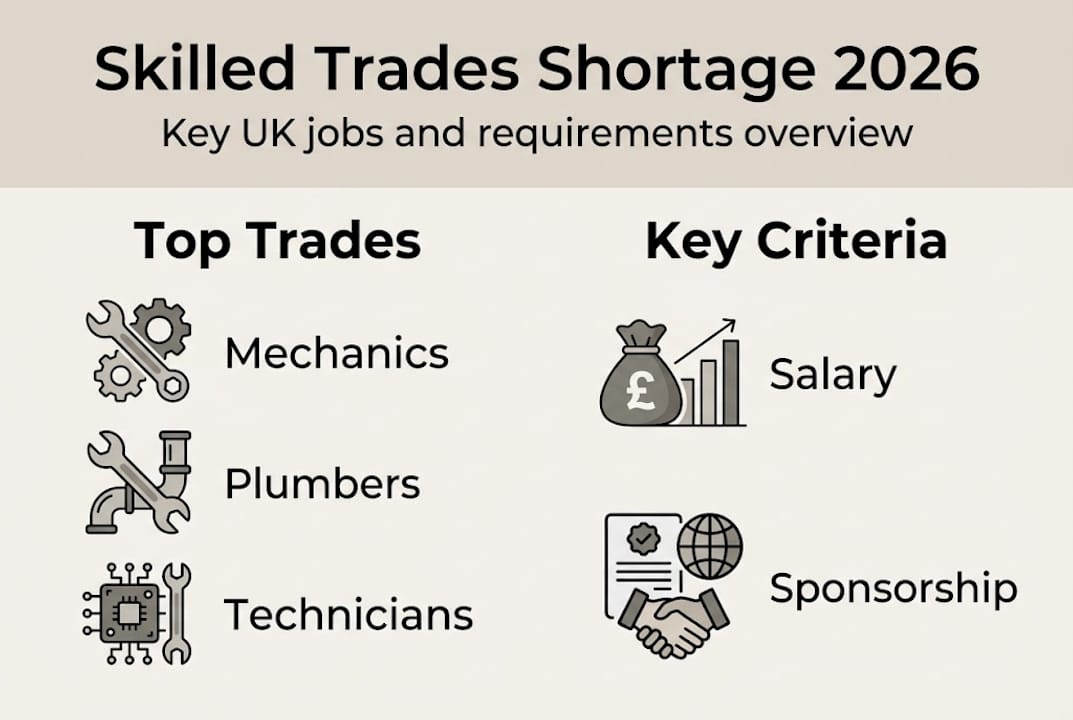
All salary rates are pro-rated based on hours, meaning a part-time mechanic earning £35,500 annually at 40 hours per week would need to earn proportionally less if contracted for fewer hours. The going rate benchmark for mechanics sits at £35,000 and above, which aligns with current UK averages, though London weighting pushes this higher in the capital.
Here is how the two lists compare on salary flexibility:
| Feature | ISL | TSL |
|—|—|—|
| Minimum salary | £33,400 | £27,900 (lower rate) |
| Salary discount | None | Available for qualifying roles |
| Occupation level | RQF6+ | RQF3-5 |
| Expiry | No fixed end | 31 December 2026 |
| Tradeable points | Yes | Yes |
The tradeable points system allows applicants to trade a lower salary against other strengths, such as holding a PhD relevant to the role, or working in a shortage occupation. For TSL roles, the occupation itself already qualifies as a shortage, which is one of the most valuable tradeable points available.
The TSL is temporary until end-2026; what happens after December 2026 depends entirely on the MAC Stage 2 review and government policy decisions.
Key points to keep in mind:
- Salary must be paid in sterling and meet the threshold at the time of application, not at the time of job offer
- Employers in London typically offer 10-15% above national benchmarks, which can ease the salary threshold concern
- If your CoS is assigned before December 2026, you are protected under TSL rules even if the list expires before your visa is granted
For a detailed breakdown of how these figures work in practice, the visa salary requirements guide is the most practical resource available. You can also explore jobs for Turkish professionals and review top UK job sectors to understand where demand is strongest.
What most guides miss: Navigating skills lists and timing for Turkish professionals
Most guides focus on whether you are eligible. Far fewer talk about when you should apply, and that timing question is arguably more important than eligibility itself for trades workers in 2026.
The TSL is a window, not a door. It opens and closes on a government timetable, not yours. If you are a qualified mechanic or electrician reading this in mid-2026, you have a genuine and time-sensitive opportunity that may not exist in the same form after December 2026. The MAC Stage 2 review could extend the list, narrow it, or replace it entirely.
Another point that generic guides consistently overlook: the quality of your sponsor matters as much as your qualifications. Sponsors who have a documented history of genuine shortages in your trade are far more credible to the Home Office than employers who added sponsorship to their licence as an afterthought. Choosing the right sponsor is a strategic decision, not just an administrative one.
Nationality is genuinely irrelevant here. Turkish-speaking professionals who meet the occupation, salary, and English criteria are on exactly the same footing as any other applicant. The visa guide for Turkish applicants reflects this reality and focuses on what actually moves the needle: occupation match, salary evidence, and sponsor credibility.
Unlock expert help for your UK skilled worker journey
Navigating the ISL, TSL, salary thresholds, and sponsor requirements on your own is possible, but it is also where many applications go wrong. Small errors in salary calculations or sponsor selection can lead to refusals that are entirely avoidable.
At UK Visa Assistance, we are regulated by the Immigration Advice Authority (IAA) at Level 1 (Ref No. F202000206), and we specialise in helping Turkish-speaking skilled workers secure the right sponsorship and build strong visa applications. Whether you need help understanding the Skilled Worker Visa salary guide, want to find a UK sponsor in your trade, or are ready to explore skilled jobs for Turkish applicants, our team is ready to guide you through every step before the TSL deadline arrives.
Frequently asked questions
Can Turkish mechanics apply for UK skilled worker visas under TSL?
Yes, Turkish mechanics (SOC 5231) qualify under the Temporary Shortage List until December 2026, provided they are sponsored by a licensed employer and meet salary and English language requirements.
What is the minimum salary for shortage occupations in 2026?
The ISL minimum salary is £33,400 as of 2026, while TSL mechanics may qualify at the lower rate of £27,900 depending on their circumstances.
Is the list open to all nationalities including Turkish-speaking professionals?
Yes, there are no nationality restrictions. Eligibility is based on skills, English proficiency, valid sponsorship, and meeting the relevant salary threshold, regardless of where you are from.
Will TSL occupations remain available after 2026?
The TSL is only valid until 31 December 2026. Whether trades occupations remain eligible after that date will depend on the MAC Stage 2 review and subsequent government policy decisions.
Recommended
- Skilled worker jobs in the UK for Turkish applicants 2026
- UK skilled worker visa explained: 2026 guide for Turkish professionals
- UK Skilled Worker Visa 2026: Rules, Salary and Sponsor Companies – METIN.LONDON
- UK skilled worker visa guide for Turkish professionals 2026
- How to attract top security talent in the UK in 2026|SJB