TL;DR:
- The UK Expansion Worker Visa requires a genuine business plan, verified documents, and specific eligibility criteria.
- Proper preparation includes certified translations, detailed financial projections, and demonstrating active trading for three years.
- Expert guidance can help navigate complex requirements, increasing the chances of successful UK business expansion.
Expanding your business to the United Kingdom is one of the most exciting moves a Turkish entrepreneur or professional can make. Yet the UK Expansion Worker Visa process stops many ambitious people in their tracks before they even begin. The paperwork feels overwhelming, the eligibility rules seem opaque, and the fear of rejection can paralyse even the most determined applicant. This guide walks you through every stage of the process clearly and practically, from understanding the core requirements to submitting a polished application that the Home Office cannot ignore. Genuine intent and thorough preparation are your two greatest assets.
Table of Contents
- Understanding the UK Expansion Worker visa requirements
- Preparing your business documents for UK Home Office review
- Step-by-step application process for the UK Expansion Worker visa
- Common mistakes and how to avoid UK visa refusals
- What most guides miss: The real hurdles for Turkish professionals
- How METIN.LONDON can support your UK business expansion
- Frequently asked questions
Key Takeaways
| Point | Details |
|---|---|
| Essential criteria | You must meet salary, occupation, English, and business requirements for the UK Expansion Worker Visa. |
| Strong documentation | Provide detailed business plans and evidence of your company’s history to prove genuine expansion. |
| Stepwise process | Follow each application step from sponsorship to biometrics to avoid common pitfalls. |
| Avoid mistakes | Double-check all details and documents to minimise the risk of refusal. |
| Expert support | Consider specialist services to maximise your chances of a successful UK expansion. |
Understanding the UK Expansion Worker visa requirements
Before you prepare a single document, you must understand exactly what the UK Home Office is looking for. The Expansion Worker route sits within the Global Business Mobility category and is designed for senior or specialist employees sent by an overseas business to establish a UK presence. This is not a route for junior staff or general workers.
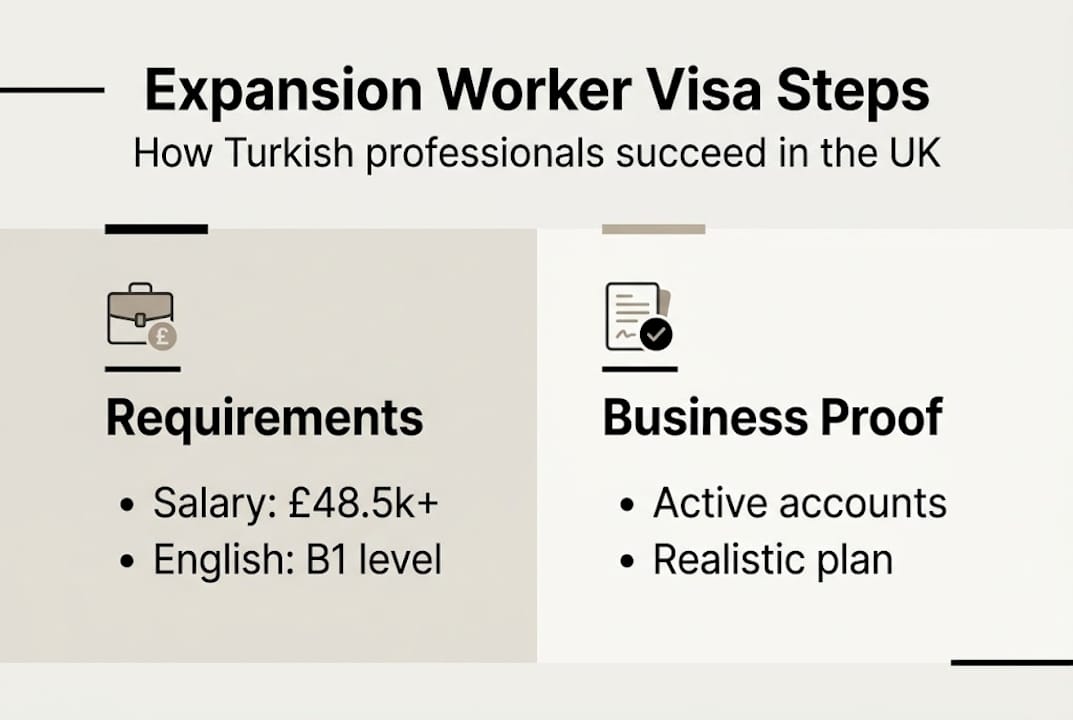
The core eligibility criteria include a minimum salary of £48,500 or the going rate for your occupation, whichever is higher. Your role must sit at RQF Level 3 or above, you must demonstrate English proficiency at B1 level, and a tuberculosis (TB) test is required if you are travelling from a country on the Home Office list. Crucially, the vacancy must be genuine: no padding out roles to meet a threshold.
Key eligibility checklist:
- Minimum salary of £48,500 or the occupational going rate (higher of the two applies)
- Eligible occupation at RQF3 or above on the permitted occupation list
- English language at B1 CEFR level
- TB clearance certificate if required for your country of residence
- A genuine, non-junior vacancy with a licensed UK sponsor
- Evidence that the overseas business is actively trading and intends genuine UK expansion
One aspect that trips up many Turkish applicants is underestimating the English language requirement. B1 is a functional level, but your evidence must come from an approved provider. A generic certificate from an unrecognised institution will cause delays or refusal.
| Requirement | Detail | Common mistake |
|---|---|---|
| Salary | £48,500 minimum or going rate | Using the base figure when the going rate is higher |
| Occupation | RQF3+ on permitted list | Applying in an ineligible role |
| English | B1 from approved provider | Using unrecognised test results |
| TB test | Required for listed countries | Missing or outdated certificate |
| Business intent | Genuine expansion evidence | Vague or generic business plan |
For reference, understanding skilled worker salary requirements alongside the Expansion Worker route can help you map out your options clearly. The sponsor company rules are equally important to review before proceeding.
Pro Tip: Never submit a generic business plan copied from a template. Home Office caseworkers review hundreds of applications and immediately spot boilerplate language. Your plan must be specific, financially credible, and tailored to your actual UK expansion strategy.
Preparing your business documents for UK Home Office review
With an understanding of the basic requirements, it is crucial to gather all the right business documentation to support your application. The Home Office does not take your word for it: every claim about your business must be backed by verifiable, well-organised evidence.
The Home Office expects overseas businesses to demonstrate genuine expansion intent through a detailed business plan, financial projections, and proof of at least three years of active trading outside the UK. This scrutiny exists specifically to prevent abuse of the route by businesses with no real operations.
Core business documents you must prepare:
- Audited accounts for at least the past three financial years
- Proof of your overseas business address, such as a lease agreement or utility bill
- A detailed UK business plan with realistic financial projections for at least two years
- CVs of key staff who will be involved in the UK operation
- Evidence of ongoing commercial contracts or client relationships
- Bank statements showing regular business activity
Every non-English document must be accompanied by a certified translation. This is non-negotiable. The translation must confirm it is accurate and complete, include the translator’s credentials, and match the format of the original document. Submitting uncertified translations is one of the fastest ways to trigger a refusal.

| Document type | What it should demonstrate | Format required |
|---|---|---|
| Audited accounts | Profitable, active trading | Certified by an accountant |
| Business plan | Clear UK expansion rationale | Detailed, structured, UK-standard |
| Lease or title deed | Genuine overseas premises | Certified translation if non-English |
| Bank statements | Regular business cash flow | Recent (within 3 months) |
| Key staff CVs | Senior expertise and continuity | English language version |
For applicants who need to demonstrate a UK base, understanding property inspection documentation is worth your attention, particularly if your UK premises will form part of your submission.
Pro Tip: Match the name, registration number, and address on every document to your business registration exactly. Any inconsistency between documents, no matter how small, raises flags that can lead to a request for further information or outright refusal.
Step-by-step application process for the UK Expansion Worker visa
Now that your documents are ready, you can navigate the full application process step by step. Many applicants are surprised by how many moving parts there are, but each stage is manageable if you prepare in advance.
The main stages are:
- Obtain a UK sponsor licence. Your UK entity, or the UK entity you are establishing, must hold a valid Global Business Mobility sponsor licence from the Home Office before any application is submitted.
- Assign a Certificate of Sponsorship (CoS). Once licenced, the sponsor assigns you a CoS, which contains your job title, salary, and start date. This is your anchor document.
- Gather and verify all personal and business documents. This includes your passport, English language certificate, TB test result, and all business evidence outlined in the previous section.
- Complete the online visa application. You apply through the official UK Visas and Immigration portal, paying the application fee and the Immigration Health Surcharge.
- Book and attend a biometric appointment. You will visit a Visa Application Centre in Turkey to provide fingerprints and a photograph.
- Await a decision. Standard processing runs to around three weeks, though this can vary by volume and complexity.
According to the eligibility framework, the role must meet salary and occupation requirements at the point the CoS is assigned, not later. Errors at the CoS stage are difficult to correct after submission.
Common errors to avoid:
- Submitting expired identity documents
- Inconsistencies between the CoS details and your application form
- Missing or unsigned declarations
- Incorrect fee payment
- Not allowing sufficient time for the biometric appointment slot
For a broader view of how the route fits alongside other options, the UK skilled worker journey provides useful context. If you plan to bring your family, reviewing adding dependants early will save time later.
Pro Tip: Application volumes at the Istanbul Visa Application Centre tend to be lower in early spring and autumn. Scheduling your biometric appointment during these periods often results in shorter waits and a smoother overall experience.
Common mistakes and how to avoid UK visa refusals
Even carefully prepared applications can face challenges, so it is essential to be aware of common pitfalls and solutions. Refusal is not the end of the road, but avoiding it in the first place saves months and significant cost.
The most frequent reasons Turkish applicants face refusal include an unconvincing or vague business plan, insufficient evidence of trading history, and discrepancies between documents submitted at different stages of the application.
“The Home Office scrutinises applications rigorously to prevent abuse of the route and expects thorough, honest documentation throughout. Applications that appear inconsistent or superficial will face refusal.”
Practical solutions to reduce refusal risk:
- Double-check every document against the Home Office guidance checklist before submission
- Use a certified, professional translator for all Turkish-language documents
- Ensure your business plan is written in plain, credible English with realistic financials
- Engage a regulated immigration adviser if you have complex circumstances
- Respond to any request for further information promptly and completely
- Keep copies of every document submitted in case you need to reference them post-decision
If you do receive a refusal, read the refusal letter carefully. It will state specific reasons, and you have the right to submit fresh evidence in a new application addressing those points directly. Acting quickly matters, as your CoS may have an expiry date.
For Turkish professionals who have built exceptional careers and want to explore alternative pathways, the global talent pathway may be worth considering alongside the Expansion Worker route.
What most guides miss: The real hurdles for Turkish professionals
Most articles about the UK Expansion Worker Visa give you a clean list of steps and leave it there. The reality for Turkish applicants is more layered than that, and we think you deserve an honest account.
Home Office scrutiny is frequently more intensive for applicants from emerging markets, including Turkey. This is not an accusation: it is simply the operational reality. Caseworkers apply additional attention when the business is based in a country where documentation standards differ from UK norms. Your accounts may be perfectly legal in Turkey but formatted in ways that raise questions for a UK reviewer.
Language is another real barrier. Business terminology translates imperfectly, and a plan that sounds authoritative in Turkish can read as vague in English if the translation is merely adequate rather than excellent. The nuance of your commercial strategy must survive the translation process intact.
Finally, there is the expectation mismatch. Turkish entrepreneurs often underestimate how much detail the Home Office wants about the why of UK expansion: why now, why the UK, and why this specific person. Providing clear answers to these questions, supported by evidence of navigating sponsorship requirements, is genuinely what separates successful applications from rejected ones.
How METIN.LONDON can support your UK business expansion
Getting expert help can turn ambitions into reality and prevent avoidable mistakes.
At UK Visa & Recruitment Services, we are regulated by the Immigration Advice Authority (IAA) at Level 1 and work with Turkish-speaking professionals and entrepreneurs every day. We understand the specific challenges you face, from certified translation standards to crafting a business plan that satisfies Home Office expectations. Our team supports you with every stage, from initial eligibility checks to preparing your full documentation package.
We also assist with property inspection services for those needing to evidence a UK base, and if you are considering setting up a UK company, our self-sponsorship guide outlines how that pathway works alongside the Expansion Worker route. Speak with our team today to take the first confident step.
Frequently asked questions
What are the key eligibility requirements for a UK Expansion Worker Visa?
You need a minimum salary of £48,500 or the going rate for your occupation, whichever is higher, alongside an RQF3+ role, English at B1 level, and a genuine UK business expansion plan backed by a licensed sponsor.
How can I prove genuine business expansion to the UK Home Office?
Submit a thorough business plan, realistic financial projections, and evidence of at least three years of active and successful trading outside the UK, all supported by certified documents.
What documents must be translated for the application?
Any non-English documents, such as Turkish business accounts or contracts, must be accompanied by a certified translation that meets UK Home Office standards and includes the translator’s credentials.
How long does the application process typically take?
The full process, from securing a sponsor licence to receiving a visa decision, can take several weeks; standard visa processing alone runs to around three weeks once the application is submitted.
Can I apply with my family as dependants?
Yes, eligible dependants such as a spouse or children may accompany you if you meet the relevant financial and relationship requirements set by the Home Office.
Recommended
- UK skilled worker visa guide for Turkish professionals 2026
- How to find UK jobs: A practical guide for Turkish newcomers
- Skilled worker jobs in the UK for Turkish applicants 2026
- UK immigration guide for Turkish nationals: visas 2026
- Navigating Work Visas and Residence Permits for EU Residents » Incorpore