TL;DR:
- Turkish health professionals are migrating mainly due to poor salaries, safety issues, and limited career growth.
- The UK offers better pay, legal protections, and structured career paths through the Health and Care Worker Visa.
- Success requires careful planning, language proficiency, credential recognition, and working with expert advisors.
Turkish physician applications to work in the UK rose from 59 in 2012 to 2,685 in 2022, a staggering 45-fold increase in a single decade. If you are a doctor, nurse, or allied health professional in Turkey, you have almost certainly felt the pressures that are driving this shift. Low salaries, relentless workloads, and safety concerns at work are no longer abstract complaints; they are lived realities shaping career decisions across the country. This article breaks down exactly why Turkish health workers are heading to the UK, what the visa process looks like in 2026, and what pitfalls you must avoid before you take the first step.
Table of Contents
- Understanding the push: why Turkish health professionals seek opportunities abroad
- Finding a pull: why the UK appeals to Turkish health workers
- Navigating the Health and Care Worker Visa: essentials in 2026
- Challenges, pitfalls and realities: what Turkish healthcare migrants must know
- An inside view: what the numbers and changes really mean for Turkish health workers
- Expert support for your UK health worker journey
- Frequently asked questions
Key Takeaways
| Point | Details |
|---|---|
| Major push factors | Low pay, poor working conditions and safety issues are driving Turkish health professionals to seek opportunities abroad. |
| UK pull factors | The UK offers better pay, safer workplaces, professional respect and streamlined visa pathways for qualified health workers. |
| Visa process essentials | Navigating the Health and Care Worker Visa requires English proficiency, sponsorship and registration—recent rule changes make preparation crucial. |
| New challenges | Higher English requirements, restricted roles, and credential hurdles mean careful planning is vital for successful migration. |
Understanding the push: why Turkish health professionals seek opportunities abroad
The decision to leave Turkey is rarely impulsive. It builds slowly, under the weight of compounding pressures that erode both income and professional dignity. Understanding these forces is the first step in deciding whether migration is the right move for you.
Economic stress sits at the heart of the matter. Over 40% of Turkish nurses cite poor economic conditions as their primary reason for wanting to migrate. Inflation has repeatedly outpaced salary increases in the public health sector, leaving many professionals earning wages that do not reflect their years of training or the demands of their roles. For specialists who have invested a decade in education, this disconnect is particularly demoralising.
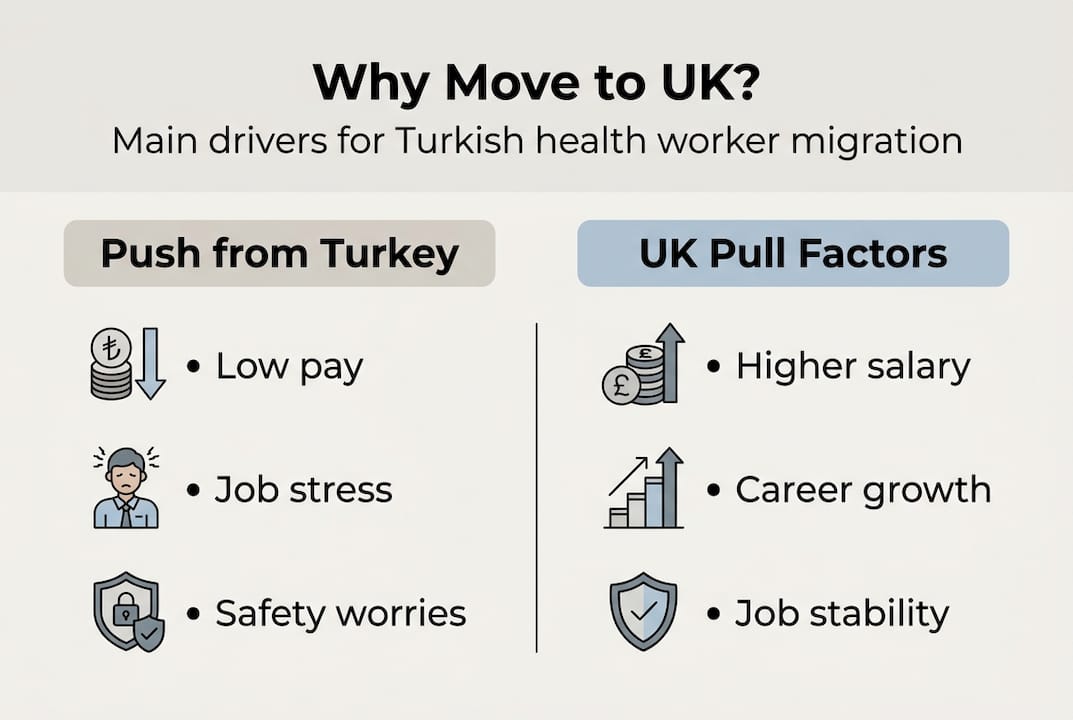
The situation among medical students paints an equally stark picture. 70.8% of medical students cite demanding working conditions as a reason to consider emigration, while 64.1% point specifically to workplace violence. These are not fringe concerns. Violence against health workers in Turkey has been widely documented, and many professionals report feeling unsupported by institutional responses.
Common push factors driving Turkish health workers abroad include:
- Low and stagnating salaries that fail to keep pace with inflation
- Excessive working hours with limited rest periods between shifts
- Workplace violence from patients and their families, with inadequate legal protection
- Limited professional autonomy, with bureaucratic structures constraining clinical decisions
- Lack of career progression in a system that rewards seniority over performance
Yet there is an important nuance here. The intention-action gap in Turkey for medical migration stands at 4.16 to 1 in 2022, meaning that for every person who actually emigrates, more than four others want to but do not follow through. Language barriers, credential recognition challenges, and financial constraints stop many from converting aspiration into action. If you are considering moving to the UK for work, understanding this gap is crucial, because the professionals who succeed are the ones who plan methodically rather than react emotionally.
“The system is not broken for everyone, but for a growing number of Turkish health professionals, the cost of staying is beginning to outweigh the cost of leaving.”
Finding a pull: why the UK appeals to Turkish health workers
While Turkey pushes, the UK pulls. And it does so with a combination of financial incentives, professional respect, and legal pathways that are difficult to ignore.

Salary is the most immediate draw. NHS roles for doctors and nurses offer minimum salaries of £25,000 or above, with specialist positions paying considerably more. Beyond the base figure, Health and Care Worker Visa holders are exempt from the Immigration Health Surcharge, saving thousands of pounds over the course of a visa. That exemption alone represents a meaningful financial advantage over other visa routes.
The benefits of the UK health visa extend well beyond salary. Consider the following:
- Professional autonomy: NHS clinical environments generally allow doctors and nurses to exercise independent judgement within clear governance frameworks
- Safer workplaces: Robust legal protections and institutional policies reduce the risk of patient-on-staff violence
- Career development: Structured training pathways, CPD funding, and access to postgraduate qualifications
- Settlement pathway: After five years on a qualifying visa, you become eligible for Indefinite Leave to Remain (ILR), offering long-term stability
- Family inclusion: Eligible applicants can bring dependants, subject to current rules (see below)
| Factor | Turkey | UK |
|---|---|---|
| Average nurse salary | Low relative to cost of living | £28,000 to £38,000+ |
| Workplace safety protections | Limited enforcement | Strong legal framework |
| Career progression | Seniority-based | Performance and training-based |
| Settlement pathway | N/A | ILR after 5 years |
| Health surcharge | N/A | Exempt for visa holders |
Pro Tip: Before comparing salaries, research the cost of living in the specific UK city where you plan to work. London pays more but costs significantly more. Cities like Leeds, Manchester, and Birmingham offer strong NHS salaries with considerably lower living expenses, making your net financial position much stronger.
The UK Health and Care Visa guidance confirms that the route is specifically designed to facilitate recruitment of overseas health professionals, reflecting the UK’s genuine and ongoing need for international talent.
Navigating the Health and Care Worker Visa: essentials in 2026
Understanding why the UK appeals is one thing. Knowing how to get there legally and efficiently is another. The Health and Care Worker Visa is the primary route for Turkish doctors, nurses, and allied health professionals, but the rules have changed significantly in recent years.
Here is the step-by-step process for 2026:
- Secure a job offer from a UK employer who holds a valid sponsor licence
- Receive a Certificate of Sponsorship (CoS) from your employer, confirming your role and salary
- Pass an English language test at CEFR B2 level or higher (IELTS Academic or OET are commonly accepted)
- Register with the GMC or NMC depending on your profession; see our guide on doctor registration requirements
- Submit your visa application online, pay the fee, and attend a biometric appointment
- Travel and begin work once your visa is granted
The visa requires employer sponsorship, a valid CoS, English proficiency at B2, salary at or above the threshold, and registration with the relevant professional body such as the GMC or NMC.
| Feature | Health and Care Worker Visa | Skilled Worker Visa |
|---|---|---|
| Health surcharge | Exempt | Must pay |
| Eligible roles | NHS and adult social care | Broad range of sectors |
| Salary threshold | Role-specific (from £25,000) | £38,700 general threshold |
| Application fee | Lower | Higher |
Critically, new restrictions from July 2025 mean that no new sponsorships are being issued for care worker roles under SOC codes 6135 and 6136. Dependant restrictions also apply to new care worker applicants. If you are a doctor or nurse, these changes do not block your route, but they do affect the broader landscape. For a full breakdown, review the detailed visa process before you begin your application. You can also apply for the UK Health and Care Worker Visa with expert support to avoid common errors.
Challenges, pitfalls and realities: what Turkish healthcare migrants must know
The visa route exists. The NHS needs staff. So why do so many Turkish health professionals fall short of completing the process? The answer lies in a cluster of practical and systemic barriers that catch applicants off guard.
Language remains the single biggest hurdle. The CEFR B2 requirement is not trivial. Many Turkish professionals have strong medical English but struggle with the conversational and listening components of IELTS Academic or OET. Failing the language test delays everything and can cost you a job offer if the employer cannot wait.
Credential recognition is the second major obstacle. The GMC and NMC have rigorous processes, and barriers for Turkish medics are well documented in academic literature. Gaps in paperwork, differences in training structures, and unfamiliarity with UK clinical governance standards all contribute to delays and rejections.
Key pitfalls to avoid:
- Assuming your qualification translates automatically: It does not. GMC and NMC assessments are thorough and take time
- Underestimating the English requirement: Start preparing for IELTS or OET at least six months before your target application date
- Applying without a confirmed sponsor: No sponsor, no visa. Do not submit applications speculatively
- Ignoring the care worker ban: If your role falls under SOC 6135 or 6136, new sponsorships are currently blocked
- Overlooking skilled worker visa requirements as an alternative if your role does not qualify for the Health and Care route
Pro Tip: Use the NHS Jobs portal and dedicated Turkish health worker jobs platforms to identify licensed sponsors before you invest time in registration. Confirming sponsorship availability first saves months of wasted effort.
The intention-action gap is real and persistent. Turkish applicants face higher-than-average drop-off rates due to these compounding barriers. Preparation, professional guidance, and realistic timelines are what separate those who arrive from those who only plan to.
An inside view: what the numbers and changes really mean for Turkish health workers
Here is something that rarely gets said plainly: the UK both needs you and is making it harder for you to come. That tension is not an accident; it is a policy reality you must navigate with clear eyes.
Visa applications fell by 51% to 13,400 main applicants in February 2026, even as the NHS carried more than 100,000 vacancies in 2025. The government is simultaneously recruiting internationally and tightening the rules. This is not contradictory; it reflects political pressure to reduce net migration figures while maintaining essential services.
What does this mean for you practically? It means the window for doctors and nurses remains open, but it is not permanent and it is not unconditional. The skilled worker visa guide is worth reading alongside the Health and Care route, because having a fallback option matters when policy shifts quickly.
Our view, shaped by working with Turkish health professionals through this process, is that flexibility is your greatest asset. The professionals who succeed are not necessarily the most qualified; they are the ones who upskill their English early, engage with GMC or NMC processes before they have a job offer, and work with advisers who understand both the Turkish medical system and UK immigration law. Assuming the process is straightforward because the NHS needs staff is the most expensive mistake you can make.
Expert support for your UK health worker journey
Navigating UK immigration as a Turkish health professional is genuinely complex, and the stakes are high. A missed document, a failed language test, or an unlicensed sponsor can set your plans back by a year or more.
At UK Visa Assistance, we are regulated by the Immigration Advice Authority (IAA) at Level 1, Ref No. F202000206, and we specialise in supporting Turkish-speaking healthcare professionals through every stage of the process. From eligibility assessments and credential recognition advice to full application management, we are with you from first enquiry to visa grant. Whether you are ready to apply for the Health and Care Worker Visa now or still exploring your options, our team can help you move forward with confidence. You can also browse verified UK health sector jobs through our platform to find licensed sponsors actively hiring Turkish professionals.
Frequently asked questions
Which NHS roles can Turkish health workers apply for in 2026?
Doctors, nurses, and allied health professionals can apply under the Health and Care Worker Visa if they meet the skill, salary, and English requirements. Eligible SOC codes cover a wide range of qualified NHS roles, but new care worker sponsorships are currently suspended.
What are the new English language requirements for Turkish doctors and nurses in the UK?
From 2026, applicants must demonstrate at least CEFR B2 level English proficiency, which is higher than previous requirements and is assessed via IELTS Academic, OET, or an equivalent approved test.
Can Turkish health workers bring family with them to the UK?
Doctors and nurses sponsored before the July 2025 rule changes can bring dependants, but new care worker restrictions mean that applicants in those roles can no longer bring family members under the current policy framework.
What are the most common reasons Turkish health workers fail to secure a UK job?
Failing the English language test, incomplete credential recognition with the GMC or NMC, and the absence of a licensed sponsor are the leading causes. The intention-action gap is high, with many applicants stalling at the preparation stage rather than completing the process.