Many Turkish nationals assume the Home Office is simply a government building that rubber-stamps visa decisions made elsewhere. In reality, it is the single most powerful force in your UK immigration journey. Every document you submit, every sponsor check, every refusal or approval flows directly through the Home Office and its operational arm, UK Visas and Immigration (UKVI). Whether you are applying for a Skilled Worker visa, a Student visa, or a Family visa, understanding how the Home Office works is not optional. It is the difference between a successful application and a costly refusal.
Table of Contents
- What is the Home Office and how does it work with UK visas?
- The Home Office decision process: checks, evidence, and outcomes
- Work, study, and family visas: how the Home Office applies the rules
- Complex cases and common challenges for Turkish applicants
- Processing times, fees, and digital changes in 2026
- Expert support for your UK visa application
- Frequently asked questions
Key Takeaways
| Point | Details |
|---|---|
| Central decision maker | The Home Office (UKVI) controls every stage of the UK visa process, from application to enforcement. |
| Evidence-driven outcomes | Visa decisions depend on meeting strict suitability, eligibility, and credibility checks with clear documentation. |
| No Turkish exemptions | Turkish citizens follow standard UK Immigration Rules except for ECAA legacy extensions. |
| Latest requirements matter | English language, finances, and digital eVisas must be current for successful outcomes in 2026. |
| Expert guidance helps | Specialist support navigating Home Office rules and application pitfalls increases your approval chances. |
What is the Home Office and how does it work with UK visas?
The Home Office is the UK government department responsible for immigration, security, and law enforcement. Within it, UKVI is the directorate that processes all UK visa applications and enforces visa conditions for every applicant, including Turkish nationals.
UKVI handles a wide range of responsibilities that directly affect your application:
- Eligibility checks: Verifying that you meet the specific requirements for your chosen visa route
- Document verification: Scrutinising every piece of evidence you submit, from bank statements to relationship proof
- Sponsor licence oversight: Confirming that your employer or educational institution holds a valid licence
- Compliance enforcement: Monitoring visa holders to ensure they abide by their conditions
- Digital transformation: Rolling out eVisas to replace physical Biometric Residence Permits (BRPs)
One important point for Turkish applicants: there is no special queue or preferential treatment. You follow the same immigration rules as any other visa national. The one historical exception was the ECAA (European Communities Association Agreement), which allowed Turkish nationals to establish businesses or work in the UK under legacy provisions. No new ECAA applications are accepted, but if you are already on this route, extensions and settlement after five continuous years of residence remain possible.
Important: If you are unsure which visa route applies to you, reviewing the types of UK visas available is a sensible first step before approaching the Home Office process.
Having established that the Home Office governs the UK visa process, let’s look at how its decision-making affects your actual application.
The Home Office decision process: checks, evidence, and outcomes
Home Office caseworkers do not make decisions based on gut feeling. They follow detailed operational guidance to assess every application across four structured pillars. Caseworkers use detailed guidance to assess validity, suitability, eligibility, and credibility for every case.
Here is how each pillar works in practice:
- Validity: Is the application formally complete? Correct fee paid, correct form used, biometrics enrolled?
- Suitability: Does anything in your history bar you from entry? Criminality, previous deception, or visa breaches trigger instant refusals here.
- Eligibility: Do you meet the specific requirements of your visa route? This covers sponsorship, finances, English language, and relationship evidence.
- Credibility: Does your application tell a consistent, believable story? Inconsistencies between documents or interview answers raise red flags.
The table below shows how these pillars translate into real outcomes:
| Pillar | What triggers failure | Likely outcome |
|---|---|---|
| Validity | Missing documents, wrong fee | Application returned |
| Suitability | Criminal record, prior deception | Mandatory refusal |
| Eligibility | Insufficient funds, no sponsor | Refusal |
| Credibility | Inconsistent evidence | Further interview or refusal |
For dependent visa rules, the credibility pillar is especially important because caseworkers look closely at whether the relationship is genuine. Similarly, for the Skilled Worker visa, eligibility checks around salary thresholds and sponsor licences are the most common stumbling blocks.
Pro Tip: Before submitting, read your own application as if you were a sceptical caseworker. Does every document support every claim? Gaps in evidence are far easier to fix before submission than after a refusal.
For a broader view of how UK immigration rules are structured, it helps to understand that the Home Office operates within a points-based system where each route has its own scoring criteria.
Now that you know what caseworkers are looking for, let’s break down the Home Office’s specific role for different visa types.
Work, study, and family visas: how the Home Office applies the rules
Each visa category triggers a different set of Home Office checks. Knowing exactly what they look for saves you time, money, and stress.
Work visas (Skilled Worker and related routes)
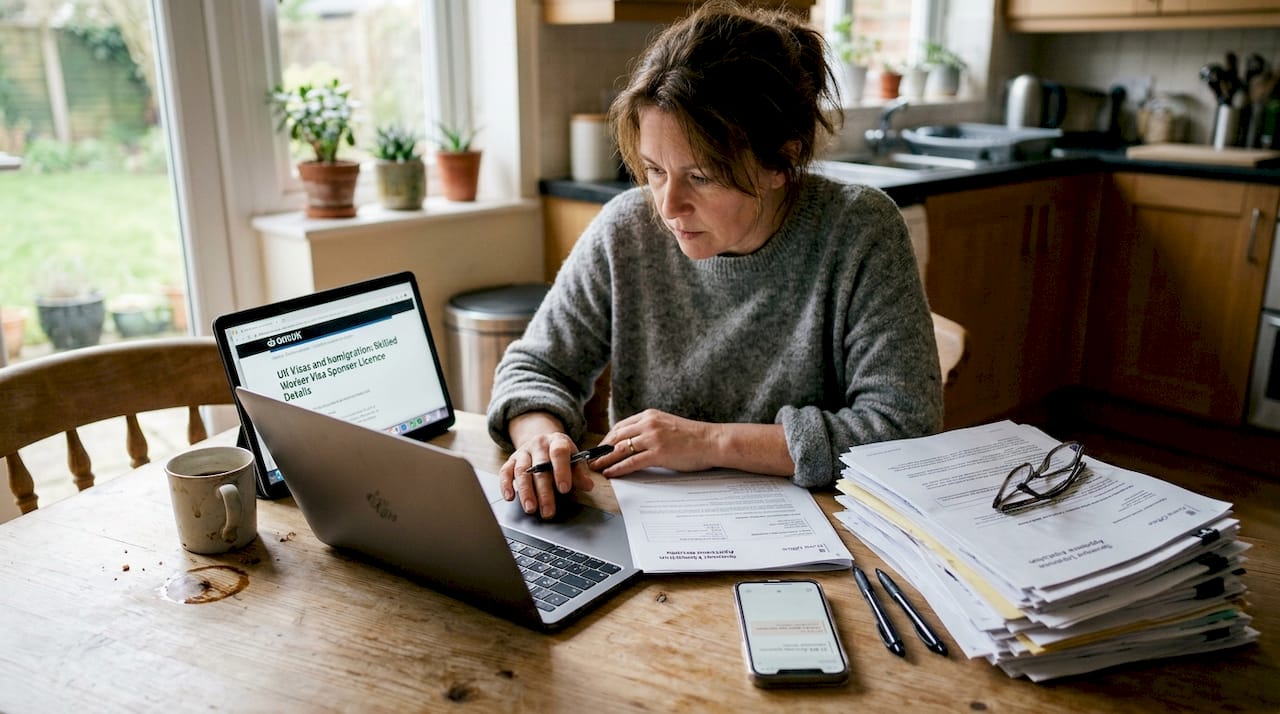
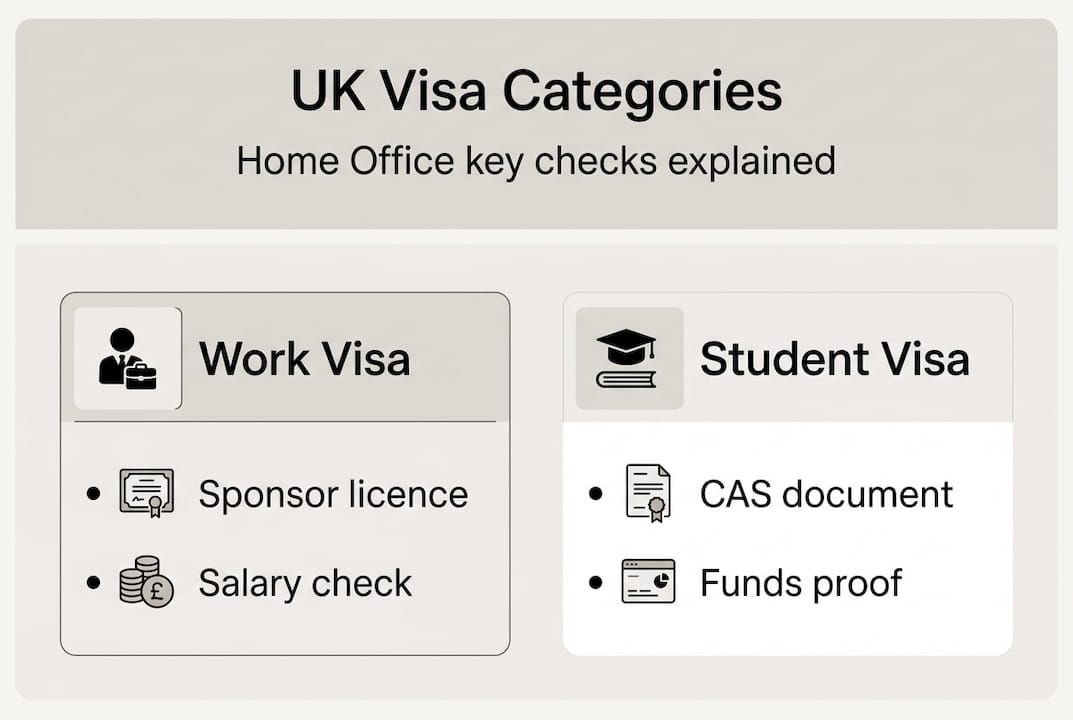
The Home Office checks sponsor licences, CAS details, salary, and English for every work visa application. From 2026, the English language requirement has been raised to B2 level for most Skilled Worker applicants. Your sponsor’s licence must be active and your Certificate of Sponsorship (CoS) must match the job role and salary you declare.
For Turkish professionals, the Skilled Worker visa remains the primary route into the UK workforce. The Home Office will also verify the source of any funds you declare, so bank statements must be clear and consistent.
Student visas
For student applications, the Home Office checks your Confirmation of Acceptance for Studies (CAS) from a licensed institution, proof of sufficient funds, English language test results, and tuberculosis (TB) screening if you are travelling from a country on the required list. Meeting the IELTS requirements for your specific course level is non-negotiable.
Family visas
Family visa decisions require adequate funds, evidence of a genuine relationship, and suitable accommodation. The financial threshold for a spouse or partner visa increased significantly in 2024 and remains at £29,000 in 2026. You must also demonstrate that your accommodation meets the required standard, which is where a property inspection report becomes essential evidence.
Here is a quick reference for what the Home Office checks across the three main routes:
| Visa type | Key Home Office checks | Common refusal reason |
|---|---|---|
| Skilled Worker | Sponsor licence, CoS, salary, English B2 | Salary below threshold |
| Student | CAS, funds, English, TB test | Insufficient funds |
| Family (spouse/partner) | Relationship evidence, finances, accommodation | Relationship not genuine |
Pro Tip: For ECAA legacy applicants, document your business activity meticulously. The Home Office expects clear evidence of continuous trading and lawful residence throughout your five-year qualifying period.
While these requirements shape most visa outcomes, some applications present unique challenges that the Home Office must consider separately.
Complex cases and common challenges for Turkish applicants
Not every application is straightforward. The Home Office applies heightened scrutiny to certain profiles, and Turkish applicants are not exempt from this.
Overstayers, frequent visitors, and legacy ECAA applicants all receive special scrutiny under Home Office guidance. Here is what that means in practice:
- Previous overstaying: Even a short overstay can trigger a suitability bar. Exceptions exist, but they are narrow and must be argued carefully.
- Frequent visits: Multiple short visits to the UK can raise questions about your true intentions. Caseworkers may question whether you are attempting to live in the UK on visitor visas.
- Prior refusals: A previous refusal does not automatically bar you, but it must be addressed directly. Submitting the same weak application again almost always results in another refusal.
- Deception or inconsistencies: Any discrepancy between your current application and previous applications is treated very seriously. The Home Office cross-references records.
- ECAA legacy cases: You must demonstrate continuous lawful residence, active business operation, and compliance with all visa conditions throughout your qualifying period.
Key reminder: eVisas are now replacing physical BRPs across all routes. If you hold a BRP, ensure your digital immigration status on the UK Visas and Immigration online service is accurate and up to date. Errors in your digital record can cause serious problems at the border or when proving your right to work.
For Turkish applicants on the Skilled Worker route, maintaining clean compliance throughout your visa period is critical for future extensions and eventual settlement. If you have dependants, understanding dependent visa rules for complex cases is equally important.
To get a full picture and set expectations, here is what to know about Home Office processing times, costs, and changes from 2026.
Processing times, fees, and digital changes in 2026
One of the most practical questions Turkish applicants ask is: how long will this take? The answer depends on your visa type, where you apply from, and whether you opt for a priority service.
| Visa type | Standard processing | Priority service | Super priority |
|---|---|---|---|
| Skilled Worker | 3–8 weeks | Available (faster) | Available (next day) |
| Student | 3–8 weeks | Available | Available |
| Family (spouse/partner) | Up to 12 weeks | Available in some cases | Limited availability |
| ECAA extension | Up to 8 weeks | Not always available | Rarely available |
The standard processing times are 3–8 weeks for work and study visas and up to 12 weeks for family visas. eVisas are replacing BRPs from 2025 onwards, and the Skilled Worker visa fee outside the UK is £719, with the Immigration Health Surcharge (IHS) set at £1,035 per year.
Key 2026 fee snapshot:
- Skilled Worker visa (outside UK, up to 3 years): £719
- IHS: £1,035 per year per person
- Student visa (outside UK): £490
- Family visa (outside UK): £1,846
For detailed breakdowns of processing times for the Skilled Worker route or spouse and dependent visa fees, these figures can shift with policy updates, so always verify before applying.
The shift to eVisas is not just administrative. It changes how you prove your immigration status to employers, landlords, and border officials. Your status now lives in a digital record, not a physical document. Keeping your contact details and passport information updated with the Home Office is no longer optional.
Expert support for your UK visa application
Navigating Home Office requirements is genuinely complex, and a single error can cost you months and hundreds of pounds. At UK Visa Assistance, regulated by the Immigration Advice Authority (IAA) at Level 1, Ref No. F202000206, we work specifically with Turkish nationals to build strong, evidence-led applications across every route.
Whether you need a property inspection report for your family visa accommodation evidence, guidance on self-sponsorship options if you want to set up a business in the UK, or help finding Skilled Worker jobs for Turkish applicants, our team is here to support you at every stage. We handle the complexity so you can focus on your future in the UK.
Frequently asked questions
Does the Home Office treat Turkish visa applicants differently?
Turkish applicants follow the same rules as other visa nationals, with no special exemptions. The only exception is ECAA legacy cases, which allow extensions or settlement after five years of continuous lawful residence for those already on that route.
What documents are essential for work or student visas?
Work visas require a Certificate of Sponsorship, job details, payslips, and an English language test at B2 level. Student visas need a CAS, bank statements covering your course fees and living costs, and TB test results if applicable. Sponsorship and salary evidence are mandatory for Skilled Worker applications.
How long does a UK visa decision take for Turkish nationals?
Outside the UK, most work and study visas are processed in 3–8 weeks, while family visas can take up to 12 weeks. Priority and super-priority services are available for some routes if you need a faster decision.
What happens if I have overstayed a UK visa before?
The Home Office will scrutinise your application closely. Exceptions exist for overstayers in limited circumstances, but any evidence of deception or repeated breaches significantly increases your risk of refusal.