Many Turkish students and professionals assume the UK visa decision is something of a lottery. It is not. Behind every outcome sits a structured, evidence-driven process that assesses your application against clear criteria. Understanding how that process works gives you a real advantage. This article breaks down exactly how UK visa applications are screened, assessed, and decided, from the first automated check through to final approval or refusal. Whether you are applying for a student visa, a skilled worker visa, or another route, knowing what happens at each stage helps you prepare a stronger, more credible application.
Table of Contents
- How UK visa applications are assessed from the start
- Core checks: Validity, suitability, and eligibility explained
- Timing and processing speeds: What really happens after you apply
- Complex cases and refusals: What triggers extra scrutiny
- How to strengthen your UK visa application: Essential tips for Turkish applicants
- A caseworker’s perspective: Why clarity and credibility matter more than you think
- Get expert support for your UK visa journey
- Frequently asked questions
Key Takeaways
| Point | Details |
|---|---|
| Automated and manual review | UK visa applications are first screened by automated tools, then assessed by experienced caseworkers for complex cases. |
| Three-stage decision process | All applications are checked for validity, suitability, and eligibility, with clear criteria for students and skilled workers. |
| Standard processing times | Typical visa decisions take three weeks from biometrics, but complex cases or missing documents can cause delays. |
| Evidence makes the difference | Providing clear, credible documents and proof of ties significantly improves your success rate. |
How UK visa applications are assessed from the start
With the confusion about the visa decision process set aside, let us break down exactly how your application enters and moves through the system.
Every UK visa application begins with an electronic screening stage before any human ever looks at it. The Home Office uses an automated tool called the Complexity Application Routing Solution, or CARS. This system reads the attributes of your application and decides whether it is straightforward or requires more careful review. UK visa applications are routed using CARS, which classifies each case as either non-complex (NCX) or complex (CX) before directing it to the appropriate decision maker.
Non-complex applications go to either an Automated Decision Maker (AODM) or an Experienced Decision Maker (EODM). Complex applications go directly to a caseworker who reviews them manually. The distinction matters enormously because it affects how quickly your case moves and what additional scrutiny it may face.
| Classification | Decision maker | Typical outcome |
|---|---|---|
| Non-complex (NCX) | AODM or EODM | Faster processing, standard checks |
| Complex (CX) | Caseworker | Manual review, possible interview |
Most Turkish applicants applying for student or skilled worker visas fall into the non-complex category, particularly when documents are complete and consistent. However, certain factors, such as previous refusals or inconsistencies in your paperwork, can push your case into the complex route. Checking your UK visa eligibility before applying helps you understand where you stand from the outset.
“The automated routing system is designed to improve efficiency, but caseworkers retain full discretion on nuanced or borderline cases. No algorithm replaces human judgement when credibility is in question.”
Understanding this distinction early means you can prepare your documents to present the clearest, most consistent picture possible.
Core checks: Validity, suitability, and eligibility explained
Once your application is routed, it faces rigorous checks at three main decision points.
Every UK visa application passes through three sequential checks. Fail any one of them and your application will not proceed. The decision-making process covers validity, suitability, and eligibility in that order.
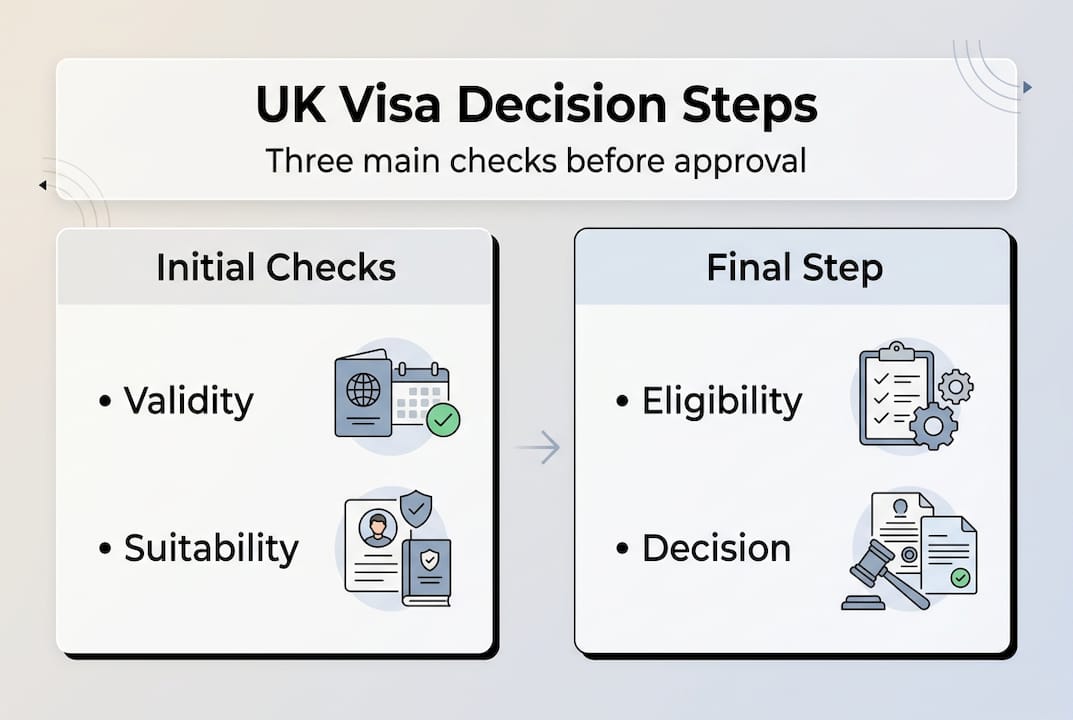
Validity is the first hurdle. Has the correct fee been paid? Are all required documents present and correctly formatted? This sounds simple, but a surprising number of applications stumble here due to missing translations or incorrect photographs.
Suitability comes next. Caseworkers look at your immigration history, any criminal record, and whether you have previously breached UK visa conditions. A past overstay or deception finding can seriously damage your case at this stage.
Eligibility is where the detail of your specific visa route is assessed. For students, this means verifying your Confirmation of Acceptance for Studies (CAS), proof of funds, English language requirements, and genuine intent to study. For skilled workers, it means checking your Certificate of Sponsorship (CoS), confirming your salary meets the threshold, and verifying the role is at the required skill level. You can find a full breakdown in our skilled worker visa explained guide.
| Requirement | Student visa | Skilled worker visa |
|---|---|---|
| Sponsor document | CAS from university | CoS from employer |
| Funds evidence | 28 days of bank statements | Not always required |
| Salary threshold | N/A | £41,700 or above |
| Skill level | N/A | RQF Level 6 or above |
| English language | Required | Required for most roles |
Common pitfalls for Turkish applicants include:
- Bank statements that do not cover the full 28-day period
- CAS or CoS numbers that do not match the application form
- English test certificates from providers not approved by the Home Office
- Inconsistent travel history details across documents
Pro Tip: Double-check every reference number on your CAS or CoS against your application form before submitting. A single digit error can trigger a validity rejection.
Timing and processing speeds: What really happens after you apply
Understanding what checks are involved is key, but so too is knowing how long each stage takes.
One of the most common misconceptions is that the processing clock starts the moment you submit your online application. It does not. Processing begins from the date you provide your biometrics or complete your identity check, not from your application submission date. This distinction can catch applicants off guard, particularly those who book travel based on their submission date.
For applications made outside the UK, the standard processing time for both student and skilled worker visas is three weeks. Inside the UK, the standard time extends to eight weeks. Priority and super-priority services are available at additional cost for many visa categories, offering decisions within five working days or even the next working day respectively.
Here is a realistic timeline of what happens after you apply:
- Submit your online application and pay the fee
- Book and attend your biometrics appointment
- Processing clock officially starts
- CARS routes your application (NCX or CX)
- Decision maker reviews your case
- Decision issued and communicated
- Passport and vignette returned if approved
In practice, volumes spike during peak periods such as September university intakes, and some cases take longer than the stated three weeks. Our guide on visa processing times covers what to expect in more detail.
Pro Tip: Turkish applicants can reduce delays by ensuring every document is translated by a certified translator and that all financial evidence is clearly labelled and in date. Incomplete evidence is the single biggest cause of processing delays.
Complex cases and refusals: What triggers extra scrutiny
For most, the process is smooth. Yet some face additional hurdles. Here is what you need to know about complex cases.
Not every application sails through the standard route. When CARS detects certain attributes, it reclassifies the case as complex and routes it to a caseworker. Complex routing is triggered by credibility issues, prior refusals, incomplete documents, or suspected fraudulent paperwork, and may result in interviews, further evidence requests, or referrals to specialist teams.
Common reasons applications are refused include:
- Insufficient funds or funds that cannot be verified
- Documents that appear inconsistent or altered
- Lack of genuine intent to study or work in the UK
- Failure to meet the English language requirement
- Immigration history issues, including overstays or previous deceptions
- Missing or expired sponsor documentation
“The Home Office takes document fraud extremely seriously. Any application where the authenticity of evidence is in doubt will be referred for further investigation, and a finding of deception can result in a ten-year ban from the UK.”
An interview may be requested if a caseworker doubts your stated intentions or cannot verify your circumstances from the documents alone. Our immigration interview guidance explains what to expect and how to prepare if you are called for one.
The good news is that most complex cases arise from preventable mistakes. Inconsistent statements, missing translations, and poorly organised evidence are far more common triggers than genuine fraud. Attention to detail at the preparation stage removes most of these risks before your application is even submitted.
How to strengthen your UK visa application: Essential tips for Turkish applicants
Knowing what puts your application at risk, let us focus on strategies to boost your odds of success.
The UK visa system is points-based for students and professionals. That means you can identify exactly where your application is strong and where it needs work. Sponsor verification and personal credibility are the two areas where Turkish applicants most often gain or lose their applications.
Here are the top steps to maximise your chances of approval:
- Establish strong ties to Turkey. Show that you have reasons to return, such as property, family, or employment. This is especially important for student visa applicants.
- Prepare your sponsor paperwork meticulously. Whether it is a CAS or a CoS, every detail must match your application exactly. If you need help finding a sponsor, do not leave it to chance.
- Provide clear, dated funds evidence. Bank statements must be in your name, cover the required period, and show sufficient funds without unexplained large deposits.
- Write a clear personal statement. Explain your reasons for choosing your specific course or employer, and why the UK is the right destination for your goals.
- Check every document for consistency. Names, dates, and reference numbers must match across every form and supporting document.
Pro Tip: Many Turkish applicants overlook the importance of certified translations. Any document not in English must be accompanied by a full, certified translation. Even a partial translation can result in a validity rejection.
The points-based structure is actually your ally. Unlike discretionary systems, it tells you precisely what you need to demonstrate. Use that clarity to your advantage.
A caseworker’s perspective: Why clarity and credibility matter more than you think
Stepping back from the step-by-step process, here is an insider’s take on what really sways the decision outcome.
There is a persistent myth that visa outcomes depend on luck, the mood of a caseworker, or some opaque bureaucratic formula. In our experience working with Turkish applicants across student, skilled worker, and family routes, the reality is far more straightforward. Caseworkers are not looking for reasons to refuse. They are looking for reasons to approve, and they need your application to make that easy for them.
Clarity matters more than volume. A concise, well-organised application with consistent evidence is far more persuasive than a thick folder of loosely related documents. Credibility matters more than perfection. A minor gap in your history, honestly explained, causes far less concern than a polished application with subtle inconsistencies.
Turkish applicants who present genuine intent, meticulous evidence, and honest explanations consistently achieve strong outcomes. The algorithm filters efficiently, but the human reviewing a complex case responds to the same qualities any reasonable person would: honesty, clarity, and preparation. Our skilled worker visa advice reflects years of working through exactly these nuances with real applicants.
Most refusals are preventable. That is not a comforting platitude. It is a practical observation based on the patterns we see repeatedly. The applicants who struggle are almost always those who underestimated the importance of preparation.
Get expert support for your UK visa journey
With a clear understanding of the process, you are ready to move forward. Here is how professional support can make your journey smoother.
At UK Visa Assistance, regulated by the Immigration Advice Authority (IAA) at Level 1, we support Turkish students and professionals at every stage of the UK visa process. From assessing your visa eligibility to preparing interview-ready documentation, our team understands the specific challenges Turkish applicants face.
We help you identify the right visa route, connect with suitable sponsors through our skilled worker jobs service, and build an application that is credible, complete, and compelling. Whether you are a student heading to a UK university or a professional targeting a skilled role, our bespoke support removes the guesswork. Visit UK Visa Assistance to speak with our advisers and take the next step with confidence.
Frequently asked questions
What does it mean if my UK visa application is classed as complex?
A complex classification means your application requires manual review by a caseworker, typically due to credibility concerns, prior refusals, or incomplete documentation. It does not automatically mean refusal, but it does mean a longer and more detailed assessment.
How long does a UK student or skilled worker visa decision take in 2026?
Standard processing is three weeks for applications submitted from outside the UK, measured from your biometrics date. Priority and super-priority services can significantly reduce this timeframe where available.
What evidence is needed to show I meet UK visa eligibility as a student?
You need a valid CAS from your sponsor institution, 28 days of bank statements showing sufficient funds, an approved English language certificate, and documentation that demonstrates your genuine intention to study.
Will a previous visa refusal affect my UK application now?
Yes, a past refusal can move your application into complex routing, but a well-prepared application with honest explanations and strong supporting evidence can still succeed.