Navigating the UK visa system can feel overwhelming, especially when conflicting advice suggests every visa type demands a job offer. The reality is far more nuanced. For Turkish nationals, understanding which visa categories require employment sponsorship and which offer alternative pathways is essential for successful applications. This guide clarifies the role of job offers across UK visa types, from Skilled Worker visas requiring licensed sponsorship to Turkish ECAA Worker visas with unique exemptions, helping you identify the right route for your circumstances and avoid costly application mistakes.
Table of Contents
- Key takeaways
- How a job offer influences skilled worker visa eligibility
- Understanding job offer requirements for Turkish visa applicants beyond skilled worker category
- Common challenges and nuances in job offer requirements for UK work visas
- Practical guidance on leveraging job offers in UK visa applications
- How METIN.LONDON can support your UK visa journey
- Frequently asked questions about job offers and UK visas
Key Takeaways
| Point | Details |
|---|---|
| Skilled Worker sponsorship needed | A qualifying job offer is required with a valid sponsor licence, and it must meet 20 mandatory points including RQF Level 6 or higher and a salary of at least £25,600 or the going rate. |
| Turkish ECAA flexibility | Turkish nationals can use the ECAA Worker visa which does not require sponsor licence or new job offers and supports extensions and settlement based on sustained employment history. |
| Student and family visas | Student visas and most family routes do not require a job offer. |
| Care worker dependants ban | From July 2025 dependants of main applicants working in care roles are not eligible for visas. |
How a job offer influences skilled worker visa eligibility
Having grasped the key takeaways, let’s explore the specifics of how job offers shape Skilled Worker visa eligibility.
The Skilled Worker visa represents the primary employment route for Turkish nationals seeking UK work opportunities. A qualifying job offer grants 20 mandatory points and must meet skill and salary requirements for the Skilled Worker visa. Without this sponsorship, your application cannot proceed regardless of your qualifications or experience.
Your prospective employer must hold a valid Home Office sponsor licence. The official sponsor guidance outlines the responsibilities employers undertake when issuing Certificates of Sponsorship. This certificate serves as your gateway to application, containing unique reference numbers and job details that immigration officials verify during assessment.
Skill level requirements have evolved significantly. From 2025 onwards, eligible positions must meet RQF Level 6 or higher, equivalent to bachelor’s degree occupations. This threshold eliminates many previously qualifying roles, narrowing options for applicants. Your job must also satisfy salary thresholds of at least £25,600 annually or the occupation’s going rate, whichever proves higher. Certain sectors like healthcare and education may qualify for reduced rates.
The Home Office scrutinises job genuineness rigorously. Immigration officials assess whether:
- The role reflects genuine business needs rather than artificial creation
- Salary levels align with industry standards for similar positions
- Your qualifications and experience match job requirements appropriately
- The employer demonstrates capacity to support the role financially
Refusals occur when caseworkers identify inconsistencies or doubts about employment authenticity. Care workers in SOC codes 6135 and 6136 face additional restrictions, with dependants no longer eligible for visas when the main applicant works in these roles since July 2025.
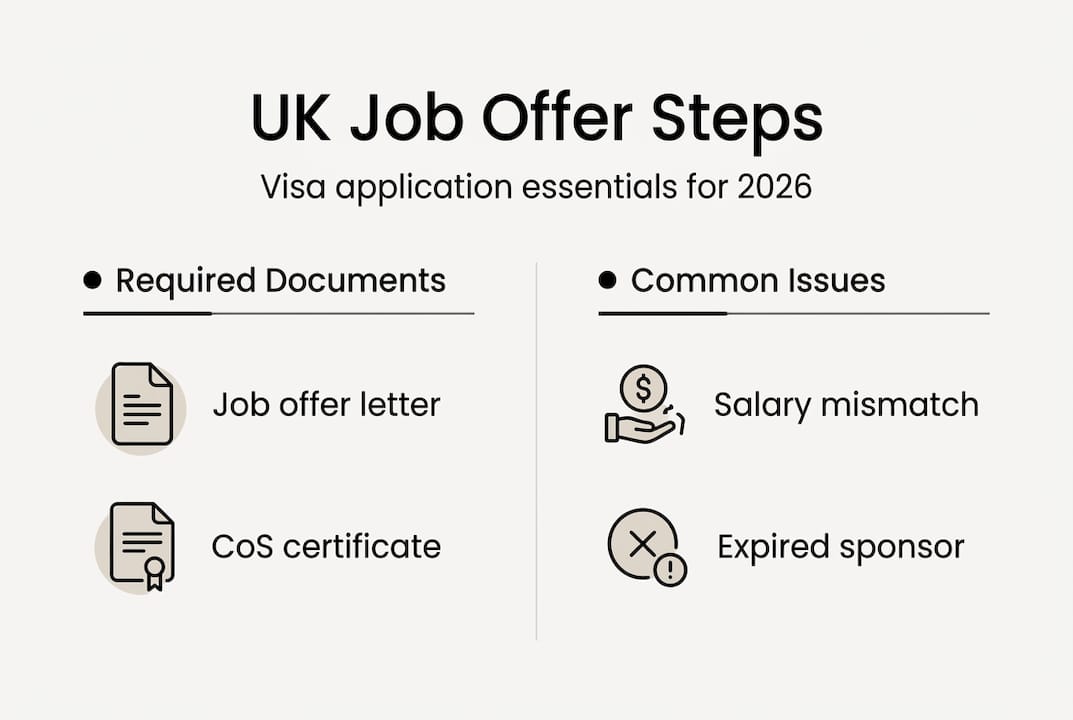
Pro tip: Ensure the Certificate of Sponsorship is valid and issued by your sponsor before application. Expired or incorrectly assigned certificates cause immediate refusals, wasting application fees and delaying your plans.
Understanding self-sponsorship visa options can provide alternative pathways if traditional employment sponsorship proves challenging to secure.
Understanding job offer requirements for Turkish visa applicants beyond skilled worker category
Whilst Skilled Worker visas demand employment sponsorship, Turkish nationals enjoy unique advantages through alternative visa categories that either minimise or eliminate job offer requirements entirely.
The Turkish ECAA Worker visa offers exceptional flexibility for Turkish citizens already working lawfully in the UK. Turkish worker visa and family reunification rules confirm extensions and settlement applications do not require sponsor licences or new job offers. This pathway allows you to extend your stay and eventually settle permanently based on continuous employment history rather than fresh sponsorship arrangements.
Student visas operate on entirely different principles. Rather than job offers, you need a Confirmation of Acceptance for Studies from a licensed educational institution. This document confirms your place on an approved course and forms the basis of your application. Employment plays no role in initial student visa approval, though switching from student to skilled worker later requires meeting job offer criteria.
Family reunification visas prioritise relationship evidence and financial capacity over employment. Whether applying as a spouse, partner, or dependent child, you demonstrate genuine relationships and adequate financial resources. The spouse visa financial requirements focus on income thresholds and savings rather than job offers. Your sponsor in the UK must prove sufficient earnings or savings, but you as the applicant need no employment commitment.
For Turkish nationals seeking to extend ECAA status or switch categories, follow these steps:
- Gather continuous employment evidence covering your entire UK residence period
- Obtain employer letters confirming job roles, salaries, and employment dates
- Compile payslips, tax documents, and bank statements showing regular salary payments
- Verify your current visa remains valid throughout the application process
- Submit extension applications before your current permission expires
- Maintain employment continuity to avoid gaps that could jeopardise settlement eligibility
Pro tip: Maintain proof of continuous employment for ECAA extensions to avoid refusals. Gaps in employment history raise questions about your eligibility and can derail otherwise straightforward applications.
Understanding dependent visa requirements helps family members plan their applications alongside your own visa journey.
Common challenges and nuances in job offer requirements for UK work visas
With differences for Turkish nationals highlighted, we now consider complex job offer scenarios and restrictions on UK work visas.
Job genuineness represents the most frequent stumbling block for Skilled Worker applicants. PBS sponsor licensing guidance confirms job offers may be refused if not genuine or if salary and skill level mismatches occur. Immigration officials investigate whether positions serve legitimate business purposes or exist solely to facilitate visa applications.
Supernumerary roles particularly attract scrutiny. These positions, created in addition to normal staffing levels, often fail genuineness tests unless employers demonstrate clear business justification. Training positions may qualify if structured properly, but casual arrangements without defined responsibilities typically result in refusals.

Salary and skill mismatches trigger automatic red flags. When your stated salary falls below the occupation’s going rate or your qualifications significantly exceed job requirements, caseworkers question the arrangement’s authenticity. Overqualified applicants accepting junior roles raise concerns about genuine employment intent.
Care worker restrictions introduced in July 2025 fundamentally altered family migration options. Individuals sponsored in SOC codes 6135 (senior care workers) and 6136 (care workers and home carers) can no longer bring dependants. This policy aims to reduce migration numbers but creates difficult choices for families.
Common refusal reasons and solutions include:
| Refusal reason | Solution |
|---|---|
| Invalid or expired Certificate of Sponsorship | Request fresh CoS from sponsor before applying |
| Salary below minimum threshold | Negotiate higher salary or seek alternative roles |
| Job not meeting skill level requirements | Target positions at RQF Level 6 or above |
| Doubts about job genuineness | Provide detailed business justification and role descriptions |
| Sponsor licence suspended or revoked | Identify alternative sponsors with active licences |
| Missing English language qualification | Obtain approved test results before application |
New entrants under 26 with PhD qualifications benefit from reduced salary thresholds, but you must still meet the going rate for your specific occupation. This nuance allows recent graduates to access opportunities whilst maintaining salary integrity across the system.
Pro tip: Confirm that job meets going rate salary especially for new entrants like PhD graduates under 26. The reduced general threshold does not override occupation-specific rates, and confusion between these figures causes preventable refusals.
Navigating these challenges successfully requires understanding how to find UK sponsors and verifying their licence status before committing to job offers. The skilled worker sponsor rules provide detailed compliance requirements employers must meet.
Practical guidance on leveraging job offers in UK visa applications
Understanding these challenges helps applicants navigate job offer nuances successfully. Next, practical tips for using job offers efficiently in visa applications.
Securing a valid job offer and Certificate of Sponsorship requires systematic preparation. Follow these steps:
- Research employers holding valid sponsor licences through the Home Office register
- Apply for positions matching your qualifications and meeting skill level requirements
- Negotiate salary packages meeting or exceeding minimum thresholds and going rates
- Request Certificate of Sponsorship once employer confirms job offer
- Verify CoS details match your passport information and job agreement exactly
- Gather supporting documents including degree certificates, English test results, and tuberculosis test certificates
- Submit visa application within three months of CoS issue date
Certificate of Sponsorship from a licensed employer is mandatory and must be secured ahead of application submission. This document contains your unique reference number, job details, and salary information that officials verify during processing.
Your documentation checklist should include:
- Valid passport with at least six months remaining validity
- Certificate of Sponsorship reference number and assignment details
- English language test results from approved providers (unless exempt)
- Tuberculosis test certificate if required for your nationality
- Degree certificates and academic transcripts for qualification verification
- Bank statements proving financial maintenance if required
- Previous visa stamps and immigration history documentation
Common mistakes to avoid include:
- Applying with invalid or incorrectly assigned Certificates of Sponsorship
- Accepting job offers with insufficient salary to meet thresholds
- Failing to verify sponsor licence status before committing to positions
- Missing English language or tuberculosis testing deadlines
- Submitting applications after Certificate of Sponsorship expires
- Providing inconsistent information across application forms and supporting documents
English language requirements remain mandatory for most applicants, with approved tests including IELTS for UKVI, Trinity College London, and Pearson PTE Academic. Exemptions apply for nationals of majority English-speaking countries and individuals with UK degree qualifications. Tuberculosis testing applies to Turkish nationals, requiring certified results from approved clinics before visa issuance.
Verifying sponsor licence status prevents wasted effort pursuing opportunities with unlicensed employers. The Home Office maintains a public register of licensed sponsors, searchable by company name and licence number. Active licences display current status, whilst suspended or revoked licences indicate employers cannot issue valid Certificates of Sponsorship.
Salary going rates vary by occupation code and require careful verification. The Home Office publishes detailed tables listing minimum salaries for each SOC code, updated annually to reflect labour market conditions. Your job offer must meet both the general threshold and occupation-specific rate.
Pro tip: Begin application preparations early to account for employer delays in issuing CoS. Sponsor companies often require internal approvals before generating certificates, and processing times vary significantly between organisations.
Exploring self-sponsorship visa options provides alternatives if traditional employment routes prove challenging. Turkish professionals can also investigate switching from student to skilled worker status if already studying in the UK. Reviewing skilled worker jobs for Turkish applicants helps identify sectors actively recruiting international talent.
How METIN.LONDON can support your UK visa journey
Following comprehensive guidance, learn how METIN.LONDON can assist you in every step of securing your UK work visa.
Navigating UK immigration requirements demands expert knowledge and careful attention to detail. METIN.LONDON specialises in supporting Turkish nationals through complex visa processes involving job offers and employment sponsorship. Our team understands the unique challenges Turkish applicants face and provides tailored guidance based on current immigration rules and policy developments.
Our comprehensive services include:
- Skilled Worker visa application support and documentation review
- Employer liaison to secure valid Certificates of Sponsorship
- Self-sponsorship visa guidance for entrepreneurs establishing UK businesses
- Recruitment assistance connecting Turkish professionals with licensed UK employers
- Turkish ECAA Worker visa extensions and settlement applications
- Family visa applications and financial requirement planning
Regulated by the Immigration Advice Authority (Level 1, Ref No. F202000206), we provide authoritative immigration advice you can trust. Whether you need help understanding salary thresholds, verifying sponsor licences, or preparing application documents, our expertise ensures your visa journey proceeds smoothly and successfully.
Frequently asked questions about job offers and UK visas
Are job offers mandatory for all UK visas?
No, job offer requirements vary significantly by visa category. Skilled Worker visas require employment sponsorship from licensed employers, but student visas need educational acceptance letters instead. Family visas focus on relationships and finances without employment requirements. Turkish ECAA Worker visa extensions do not require new job offers, offering unique flexibility for Turkish nationals already working lawfully in the UK.
What documentation proves a genuine job offer?
A valid Certificate of Sponsorship from a licensed employer provides primary evidence. Supporting documents include detailed job descriptions, employment contracts specifying salary and responsibilities, and employer letters confirming the business need for your role. Payslips and tax records demonstrate ongoing employment for extension applications. The Home Office scrutinises whether positions serve legitimate business purposes rather than existing solely for visa facilitation.
Can Turkish ECAA Worker visa holders switch to Skilled Worker visas?
Yes, switching is possible but requires meeting standard Skilled Worker criteria including a job offer from a licensed sponsor, minimum salary thresholds, and appropriate skill levels. However, ECAA visa holders should carefully consider whether switching offers advantages, as ECAA status provides settlement pathways without ongoing sponsorship requirements. Switching to Skilled Worker status means accepting more restrictive conditions and employer dependence.
What salary thresholds apply to job offers in 2026?
The general minimum salary for Skilled Worker visas is £25,600 annually, but you must also meet your occupation’s going rate, whichever proves higher. New entrants under 26, those in shortage occupations, and PhD holders may qualify for reduced thresholds. Healthcare and education sectors sometimes offer lower minimums. Going rates vary by SOC code, requiring careful verification against official Home Office tables before accepting job offers.
Are there special rules for dependants of care workers with job offers?
Yes, significant restrictions apply since July 2025. Skilled Workers sponsored in SOC codes 6135 (senior care workers) and 6136 (care workers and home carers) cannot bring dependants on their visa applications. This policy change affects both new applicants and those extending existing permission. Family members already in the UK retain their status, but new dependant applications are refused for care worker sponsors in these specific occupation codes.