Many Turkish nationals believe securing a UK visa is simply a matter of filling out forms and waiting for approval. In reality, the UK Home Office and its operational arm, UK Visas and Immigration, control every aspect of your application through rigorous assessment frameworks, policy enforcement, and security checks. Understanding how these agencies function is essential for Turkish migrants seeking work or study opportunities in 2026. This guide breaks down the Home Office’s role, current visa pathways, recent reforms affecting Turkish applicants, and practical steps to strengthen your application.
Table of Contents
- Overview Of The UK Home Office And UKVI Functions
- UK Work And Study Visa Options For Turkish Nationals In 2026
- Impact Of 2025 Immigration Reforms On Turkish Visa Applicants
- Practical Steps For Turkish Applicants: Navigating The UK Visa Process
- How METIN.LONDON Supports Your UK Visa Journey
Key takeaways
| Point | Details |
|---|---|
| Home Office controls decisions | UK Visas and Immigration processes applications and enforces immigration rules for all visa categories. |
| Points-based work visas | Most routes require sponsor certificates, minimum £26,200 salary, and B1/B2 English from 2026. |
| ECAA route closed | Turkish nationals cannot apply for new ECAA Worker visas, but existing holders retain extension rights. |
| Recent reforms tighten rules | Higher skill thresholds, extended settlement periods to 10 years, and stricter sponsor duties took effect in 2025. |
Overview of the UK Home Office and UKVI functions
The UK Home Office serves as the government department responsible for immigration policy, national security, and law enforcement. Within this structure, UK Visas and Immigration operates as the dedicated unit processing visa applications, making entry decisions, and enforcing compliance across all categories. For Turkish nationals, this means every work, study, or family visa passes through UKVI assessment channels before approval.
UKVI manages the entire application lifecycle from initial submission to final decision. You submit applications through the official GOV.UK portal, attend biometric appointments at designated centres, and provide supporting documents proving your eligibility. The agency verifies sponsor certificates, checks financial requirements, assesses English language qualifications, and conducts security screenings. This multi-layered approach ensures only applicants meeting strict criteria receive permission to enter or remain in the UK.
Visa categories processed by UKVI include:
- Skilled Worker and Health and Care Worker routes requiring sponsor certificates
- Student visas for degree programmes at licensed institutions
- Global Business Mobility for intra-company transfers
- Family visas for partners, spouses, and dependants
- Visitor visas for tourism or short business trips
The Home Office prioritises national security throughout this process. Background checks, biometric data collection, and document verification help identify potential risks before granting entry. Turkish applicants must demonstrate genuine intent, sufficient funds, and compliance with immigration rules. Failure to meet any requirement results in refusal, with limited appeal rights depending on your visa category.
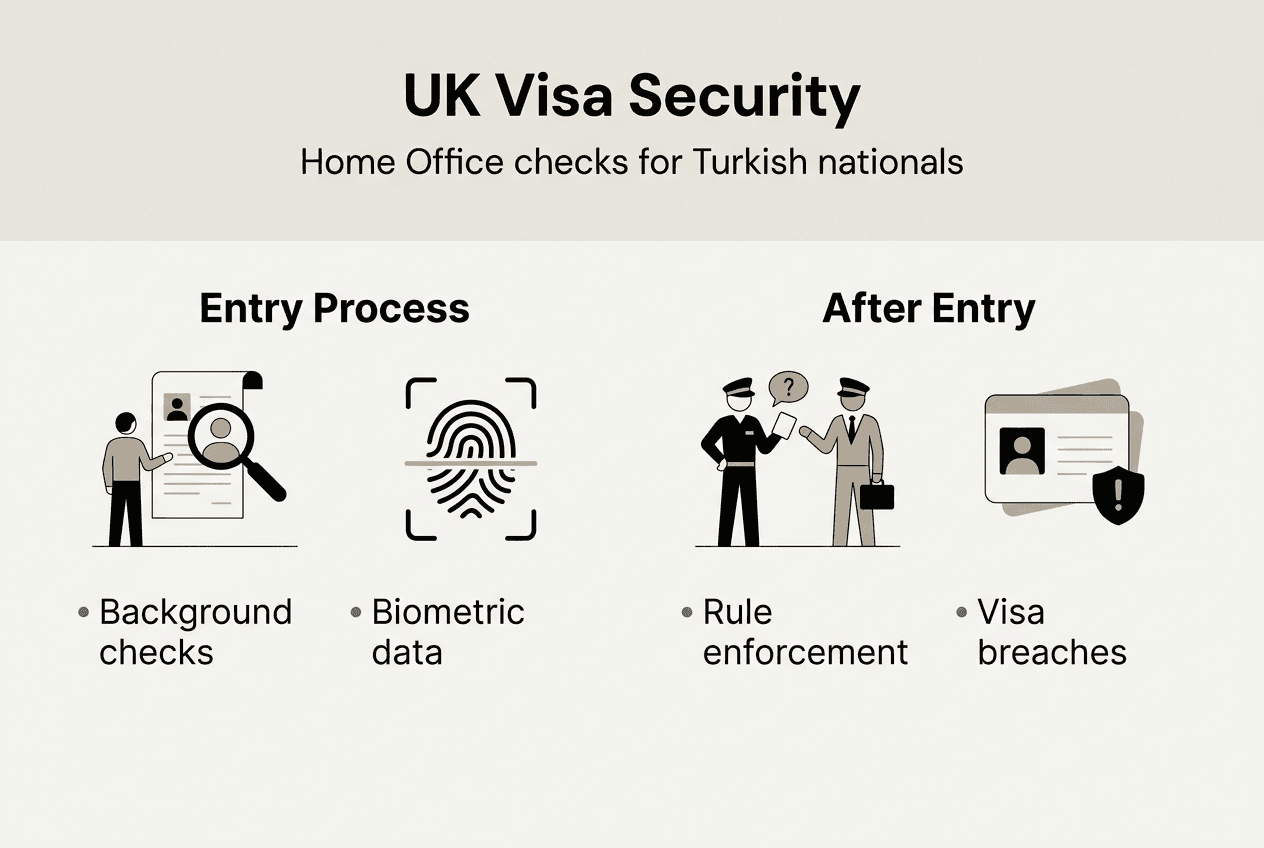
UKVI also enforces immigration rules after entry. Overstaying, working without permission, or breaching visa conditions trigger enforcement action including detention and removal. Understanding these functions helps you navigate the system correctly and avoid jeopardising your status. For comprehensive guidance on available pathways, review our types of UK visas 2026 guide.
UK work and study visa options for Turkish nationals in 2026
Turkish nationals seeking UK employment face a points-based immigration system requiring sponsor support, minimum salary thresholds, and English language competency. The primary work routes in 2026 include Skilled Worker, Health and Care Worker, and Global Business Mobility visas. Each demands a Certificate of Sponsorship from a UK employer holding a valid sponsor licence, proof of meeting salary requirements of £26,200 minimum, and English language certification at B1 or B2 level.
The Skilled Worker route covers most professional occupations listed on the UK shortage occupation list or meeting RQF Level 3 standards. Your sponsor must prove they cannot fill the role with a settled worker, and you must score sufficient points across salary, skill level, and English proficiency categories. Health and Care Worker visas offer reduced fees and faster processing for nurses, doctors, and care professionals, though social care recruitment from overseas ends by 2028 under recent reforms.
Pro Tip: Check your occupation code against the official shortage list before applying, as shortage roles qualify for lower salary thresholds and reduced visa fees.
The Turkish-specific ECAA Worker route, which previously allowed business persons and workers to enter without points-based restrictions, closed to new applicants after 2020. However, existing ECAA visa holders retain significant advantages. You can extend your stay indefinitely and qualify for Indefinite Leave to Remain after five years of continuous residence, compared to ten years for most other work visa categories. This legacy protection makes ECAA extensions valuable for Turkish nationals already in the system.
Student visas remain accessible for Turkish nationals accepted to UK universities holding sponsor licences. You need an unconditional offer, proof of funds covering tuition and living costs (£13,000 minimum for London, £10,000 elsewhere), and English language certification. Student visa holders can switch to Skilled Worker status after graduation if they secure qualifying employment, providing a pathway from study to settlement.
| Visa Type | Salary Requirement | Settlement Timeline | Key Restrictions |
|---|---|---|---|
| Skilled Worker | £26,200 minimum | 10 years from 2026 | Sponsor required, no recourse to public funds |
| Health and Care | £23,200 for most roles | 10 years from 2026 | Occupation-specific, social care ending 2028 |
| ECAA (existing) | No minimum | 5 years | Extensions only, no new applications |
| Student | Funds proof only | No direct settlement | Must switch category for ILR |
For detailed guidance on securing employment, explore our UK skilled worker visa guide for Turkish professionals.
Impact of 2025 immigration reforms on Turkish visa applicants
The UK government introduced sweeping immigration reforms through its 2025 White Paper, fundamentally altering visa eligibility and processing standards. These changes directly affect Turkish nationals by raising skill thresholds, extending settlement periods, and tightening sponsor obligations. Understanding these reforms helps you assess your eligibility and prepare stronger applications.
Key reforms affecting Turkish applicants include:
- Higher skill thresholds requiring RQF Level 6 qualifications (degree-equivalent) for most Skilled Worker roles from 2026, eliminating many Level 3 occupations previously eligible.
- Overseas social care recruitment ending by 2028, closing a major employment pathway for Turkish care workers and limiting Health and Care Worker visa grants.
- Extended settlement timelines doubling from five to ten years for most work visa categories, though ECAA holders retain their five-year pathway to Indefinite Leave to Remain.
- Increased sponsor responsibilities including quarterly compliance reporting, stricter salary verification, and enhanced due diligence on sponsored workers.
- Stricter financial requirements and document verification standards reducing approval rates across all categories.
These reforms aim to reduce net migration by prioritising UK workforce training over overseas recruitment. The Home Office reported a 20% decline in work and study visa grants following implementation, with processing times extending for complex applications. Turkish nationals face heightened scrutiny on document authenticity, financial capacity, and genuine intent.
Pro Tip: Prepare comprehensive evidence of your qualifications, employment history, and financial stability before applying, as reforms increase the likelihood of requests for additional documentation.
“Recent reforms prioritise higher skills thresholds, stricter sponsor duties, and extended settlement periods, fundamentally reshaping UK immigration policy to reduce reliance on overseas workers whilst maintaining pathways for genuine talent.”
The salary threshold increase to £26,200 affects Turkish applicants in lower-paid professional roles. If your occupation previously qualified at £20,960, you now need either a higher salary offer or qualification for a shortage occupation exception. Review our skilled worker visa salary requirements 2026 for occupation-specific thresholds.

Despite tightening rules, the UK remains attractive for Turkish professionals in high-demand sectors. Technology, healthcare, engineering, and finance roles continue offering strong opportunities. Our guide on why move to the UK for work in 2026 explores sector-specific advantages and career progression pathways.
Practical steps for Turkish applicants: navigating the UK visa process
Successfully securing a UK visa requires meticulous preparation, accurate documentation, and understanding of procedural requirements. Turkish nationals must navigate multiple stages from initial application through biometric collection to final decision. Following this structured approach increases your approval chances and reduces processing delays.
Follow these steps for a complete application:
- Secure a job offer from a licensed UK sponsor and obtain your Certificate of Sponsorship reference number before starting your application.
- Register on the official GOV.UK visa application portal and complete the online form accurately, ensuring all details match your supporting documents.
- Pay the visa fee, Immigration Health Surcharge, and book your biometric appointment at a designated visa application centre.
- Gather required documents including passport, sponsor certificate, English language test results, financial evidence, and tuberculosis test certificate if you have lived in Turkey for more than six months.
- Attend your biometric appointment to provide fingerprints and photographs, submitting all supporting documents either physically or via online upload.
- Track your application status through the online portal and respond promptly to any requests for additional information.
Document requirements vary by visa category but typically include:
- Valid passport with at least six months remaining validity
- Certificate of Sponsorship from your UK employer
- Proof of English language ability through approved test providers or qualifying degree taught in English
- Bank statements showing required funds held for 28 consecutive days (£13,000 for London students, £10,000 elsewhere)
- Tuberculosis test results from approved clinics if you have resided in Turkey for over six months
- Academic transcripts and qualification certificates for study or skilled work applications
Pro Tip: Organise documents in the exact order listed in your application checklist, using clear labels and translations for any non-English materials to streamline processing.
Processing times typically range from three weeks for standard applications to eight weeks for complex cases requiring additional verification. ECAA applications often face longer delays due to manual assessment of legacy rights. Priority and super-priority services offer faster decisions for additional fees, though availability varies by location and application type.
Turkish residents must complete tuberculosis testing at designated clinics before applying for visas longer than six months. This requirement adds approximately two weeks to your preparation timeline. Book your test early to avoid delays, and ensure results remain valid throughout your application process.
Common pitfalls include insufficient financial evidence, expired English language certificates, and discrepancies between application forms and supporting documents. Triple-check every detail before submission, as errors trigger refusals or requests for clarification that extend processing times. For occupation-specific guidance, review our skilled worker jobs for Turkish applicants.
If you plan to bring family members, explore dependent visa requirements to understand additional documentation and financial thresholds. Spouses and children can accompany you on most work visas, provided you meet enhanced financial requirements.
Prepare for potential immigration interviews by reviewing your application thoroughly and understanding your sponsor’s business, your role responsibilities, and your long-term career plans in the UK. Credibility interviews assess genuine intent and help identify fraudulent applications.
How METIN.LONDON supports your UK visa journey
Navigating UK immigration rules demands expertise, particularly as reforms tighten eligibility criteria and processing standards. METIN.LONDON offers comprehensive UK visa and recruitment services specifically designed for Turkish nationals seeking work or study opportunities. Our Immigration Advice Authority-regulated team guides you through every application stage, from securing sponsor certificates to preparing appeal submissions.
We specialise in matching Turkish professionals with UK employers holding sponsor licences, streamlining the Certificate of Sponsorship process for Skilled Worker applications. Our services extend to self-sponsorship visa pathways, where we help you establish a UK company and obtain your own sponsor licence. This route suits entrepreneurs and senior professionals seeking maximum flexibility.
Our recruitment division connects healthcare professionals, chefs, engineers, and IT specialists with skilled worker opportunities across the UK. We verify sponsor legitimacy, review employment contracts, and ensure salary offers meet minimum thresholds before you commit. This protection prevents fraudulent job offers and wasted application fees.
Frequently asked questions
What is the UK Home Office’s role in visa applications?
The UK Home Office, through UK Visas and Immigration, processes all visa applications, sets immigration policy, and enforces compliance with entry rules. It serves as the central government authority controlling who enters and remains in the UK.
Can Turkish nationals still apply under the ECAA Worker route?
No, the ECAA Worker route closed to new applicants in 2020 following Brexit. However, existing ECAA visa holders retain extension rights and can qualify for Indefinite Leave to Remain after five years of continuous residence.
What are the current salary and language requirements for UK skilled worker visas?
SkilledWorker visas require a minimum salary of £26,200 as of 2026, with English language competency at B1 or B2 level. Some shortage occupations qualify for reduced salary thresholds. Review our salary requirements guide for occupation-specific details.
How long does UK visa processing take for Turkish applicants?
Standard processing takes three to eight weeks depending on application complexity and category. Priority services offer faster decisions for additional fees, though ECAA applications often require extended processing due to manual assessment of legacy rights.
What documents do Turkish nationals need for UK work visa applications?
You need a valid passport, Certificate of Sponsorship from your UK employer, English language test results, bank statements proving required funds, and a tuberculosis test certificate if you have lived in Turkey for over six months. Additional documents vary by visa category and individual circumstances.