TL;DR:
- The UK refugee family reunion visa route was suspended in September 2025, affecting many Turkish families.
- Alternative visa routes like Appendix FM impose strict income and language requirements, challenging refugees’ eligibility.
- Families should prepare comprehensive documentation and seek qualified legal support to navigate new regulations before 2026.
The UK refugee family reunion visa route was suspended in September 2025, leaving thousands of families with no clear path forward. For Turkish-speaking communities in the UK, this change has created real confusion about how to legally bring loved ones to Britain. Whether your family member holds refugee status, humanitarian protection, or settled status, the rules have shifted significantly. This guide explains exactly what changed, which visa routes remain open, what evidence you need, and how to prepare for the new regulations expected in spring 2026. You will find practical, honest information here rather than vague reassurances.
Table of Contents
- Understanding the UK family reunion visa suspension
- Alternative routes: Appendix FM and current family visas
- Evidence and documentation: Proving your family relationship
- Processing times, outcomes, and what to expect in 2026
- Our take: The reality Turkish families face in UK family reunification
- Get local help for your UK family reunion visa journey
- Frequently asked questions
Key Takeaways
| Point | Details |
|---|---|
| Visa route suspended | The UK refugee family reunion visa is suspended and most applicants need alternative routes. |
| Appendix FM barriers | The current main family visa requires high income, English skills, and strict evidence, which challenges most refugees. |
| Proof of relationship | Documents, DNA, and affidavits are essential to demonstrate genuine connections, particularly for Turkish families. |
| New rules expected | Stricter UK family reunion rules involving residence and financial requirements are likely in 2026. |
| Legal guidance crucial | Specialist Turkish-speaking support and official sources like GOV.UK and UNHCR are necessary for successful applications. |
Understanding the UK family reunion visa suspension
The refugee family reunion route suspended as of 4 September 2025 was one of the most widely used pathways for families separated by conflict or persecution. Its closure affects not just new applicants but also those who were planning to apply in the near future. For Turkish families with members who arrived in the UK as refugees, this is a significant blow.
Before the suspension, the scheme allowed sponsors who held refugee status, humanitarian protection, or settlement on a protection route to bring their spouse, civil partner, and children under 18 to the UK. Eligible sponsors included refugees, those with humanitarian protection, and individuals settled on protection-based routes. The route was specifically designed to avoid placing financial barriers in the way of families who had fled danger.
The UK government cited pressures on public services, concerns about integration, and questions of fairness to other visa categories as reasons for the suspension. Critics, including the UNHCR, have argued that family unity is a fundamental right and that the suspension causes serious harm to vulnerable people.
For Turkish-speaking applicants, the impact is particularly sharp. Many Turkish refugees in the UK arrived without their immediate family members and had been relying on this route to reunite. Now they must navigate alternative visa categories that carry financial and bureaucratic requirements the old scheme deliberately avoided.
Key facts about the suspension:
- The route closed to new applications on 4 September 2025
- Existing applications already submitted before that date continue to be processed
- No confirmed date has been given for when or whether the route will reopen
- The Home Office has indicated a new policy framework is expected in spring 2026
You can explore the full range of UK visa types to understand which alternative routes may apply to your situation. The landscape has changed, but options do exist.
Alternative routes: Appendix FM and current family visas
With the refugee family reunion route closed, most families must now look at Appendix FM, which is the main framework governing family visas in the UK. This is the same route used for spouse visas, partner visas, and dependent child visas. It was not designed with refugees in mind, and that creates real challenges.
Under Appendix FM, the sponsor must meet a minimum income threshold. As of 2026, that figure stands at £29,000 per year minimum income, along with suitable accommodation and, for adult applicants, an English language requirement at A1 level. These are not small hurdles.
The problem is stark. Research shows that many refugees earn around £20,000 as a median annual income, well below the Appendix FM threshold. For Turkish refugee sponsors who are still establishing themselves in the UK workforce, this gap can feel impossible to bridge.
Here is a comparison of the two routes:
| Criteria | Old refugee family reunion | Appendix FM family visa |
|---|---|---|
| Income requirement | None | £29,000+ per year |
| English language test | Not required | A1 for adults |
| Accommodation standard | Basic adequacy | Formal adequacy assessment |
| Who can apply | Refugees, HP holders | Any settled/British sponsor |
| Application fee | Free | £1,846+ per person |
To apply under Appendix FM, you will generally need to follow these steps:
- Confirm the sponsor meets the financial requirements for a spouse visa
- Gather proof of genuine relationship (more on this in the next section)
- Arrange suitable accommodation and obtain a property inspection report if needed
- Ensure the applicant completes an approved English language test at A1 level
- Submit the application online with all supporting documents
You should also review the dependent visa new rules for 2026 if you are bringing children or other dependants, as separate criteria apply.
Pro Tip: If you are struggling with the income requirement, seek advice from a bilingual Turkish and English immigration specialist before assuming you cannot apply. There are legitimate ways to combine income sources or use savings in certain circumstances.
For additional support, UNHCR offers legal advice specifically for refugee families navigating UK family reunion options.
Evidence and documentation: Proving your family relationship
One area where many applications fail is documentation. The Home Office requires clear, credible evidence that the relationship is genuine. For Turkish families, this can involve additional steps because documents must be translated and sometimes authenticated.
According to the official guidance, accepted proof includes official documents, personal statements, and voluntary DNA testing where documentary evidence is unavailable or insufficient. Each of these carries different weight in an application.
The most commonly accepted documents include:
- Marriage certificates (must be officially translated into English by a certified translator)
- Birth certificates for children (again, certified translation required)
- Photographs showing the family together over time
- Communication records such as messages, call logs, or video call history
- Affidavits explaining the relationship where formal documents are unavailable
- Voluntary DNA test results where parentage is disputed or unproven by documents
Turkish documents present a specific challenge. Turkey uses a civil registration system, and documents such as the nüfus cüzdanı (national identity card) or aile cüzdanı (family record book) are often central to proving family ties. These must be translated by a certified translator and, in some cases, apostilled.
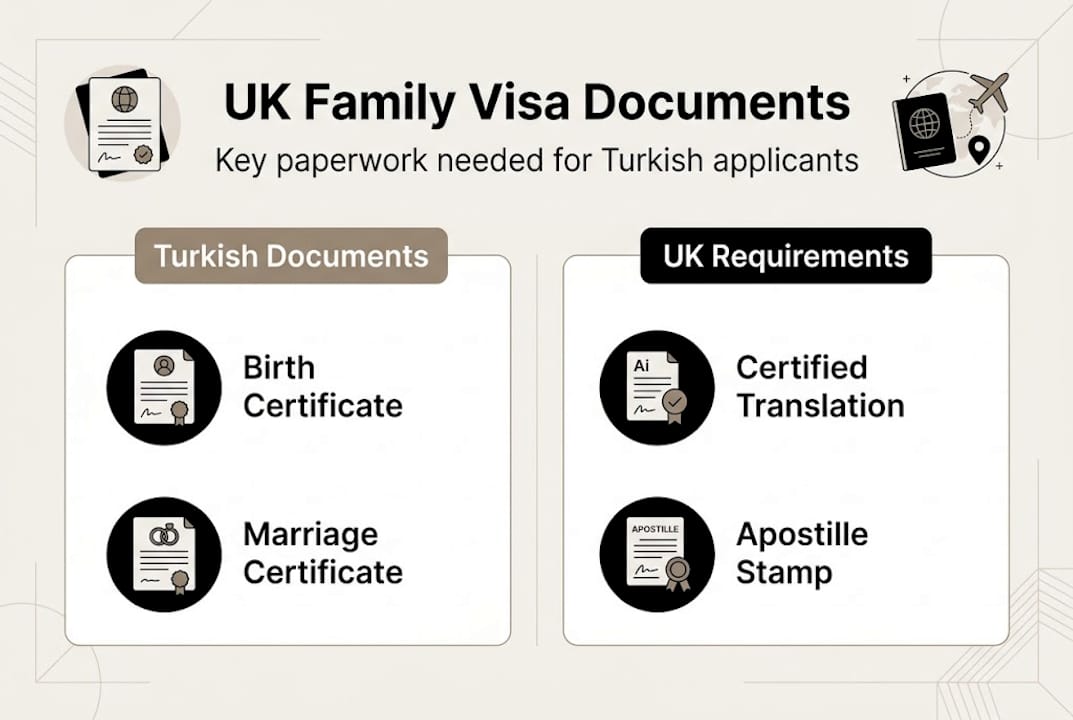
| Document type | Translation needed | Authentication needed |
|---|---|---|
| Marriage certificate | Yes | Apostille recommended |
| Birth certificate | Yes | Apostille recommended |
| DNA test results | No | Accredited lab required |
| Affidavit | Yes (if in Turkish) | Notarisation required |
Edge cases are common. If a child is over 18, they generally cannot apply under the family reunion or Appendix FM child route unless exceptional circumstances apply. Relationships formed after the sponsor fled their home country may also face additional scrutiny. For guidance on assembling a strong evidence file, the approach used in self-sponsorship visa applications offers useful parallels in terms of document organisation.
For affidavits specifically, guidance on affidavit preparation can help you understand what these statements must include to be credible.
Pro Tip: Always use a certified translator who is registered with a professional body. An uncertified translation is likely to be rejected outright, causing costly delays.
Processing times, outcomes, and what to expect in 2026
Once your application is submitted, the waiting begins. Understanding realistic timelines helps families plan and reduces unnecessary anxiety.
Historically, processing times ranged from 12 weeks to 12 months, with an 87% success rate recorded before the suspension. These figures applied to the old refugee family reunion route, which had fewer requirements. Appendix FM applications can take a similar range but may face additional delays if documentation is incomplete.
Here is what to expect at each stage:
- Online application submission: The applicant applies from outside the UK via the UKVI portal
- Biometric appointment: Fingerprints and photographs are taken at a visa application centre
- Document review: The Home Office assesses all submitted evidence
- Interview (if requested): Some applicants are called for an interview, particularly where the relationship is unclear
- Decision: Approval, refusal, or request for further information
Looking ahead, new rules are expected in spring 2026 that may introduce stricter conditions around residence periods and contribution requirements for sponsors. This means acting sooner rather than later could be to your advantage if you meet current criteria.
“Families should not wait for clarity on future rules. The best time to start preparing your application is now, with the rules as they currently stand.”
If you are called for an interview, preparation matters enormously. Reviewing what to expect at a UK immigration interview will help you and your family member feel confident and ready.
Our take: The reality Turkish families face in UK family reunification
We have supported many Turkish-speaking families through the UK immigration process, and the honest truth is this: the suspension of the refugee family reunion route has made an already difficult journey significantly harder. The income threshold under Appendix FM is not a minor administrative requirement. For a refugee who arrived with nothing and has spent years rebuilding, £29,000 per year can feel like an insurmountable barrier.
What concerns us most is the rise in misinformation. Families are turning to unofficial sources, social media groups, and well-meaning but unqualified advisors. This leads to wasted money, rejected applications, and in some cases, jeopardised immigration status.
Our strong advice: use only GOV.UK, UNHCR, and regulated immigration advisors. Review the latest dependent visa guidance and seek bilingual support where possible. There are no shortcuts. Genuine evidence and qualified legal guidance are the only things that work.
Get local help for your UK family reunion visa journey
Navigating UK immigration rules is complex enough in English. Doing it in a second language, under emotional pressure, with a family separated across borders, is genuinely difficult. That is where we come in.
At Metin London, we are regulated by the Immigration Advice Authority (IAA) at Level 1 and provide expert visa guidance in both Turkish and English. We help families understand their options, prepare documentation, and submit strong applications. We also provide professional property inspection reports required for family visa applications. If you are unsure where to start, our complete dependent visa guide is a practical first step. Reach out today and let us help you move forward.
Frequently asked questions
Can I still apply for a UK family reunion visa if my sponsor is a refugee?
As of September 2025, the refugee family reunion route is suspended for new applications, so most applicants must now use Appendix FM family visa routes instead.
What documents are needed to prove family relationships for UK visas?
You can use birth certificates, marriage certificates, DNA tests, affidavits, and translated Turkish documents. The Home Office accepts proof via documents, statements, or DNA where official records are unavailable.
How long does a UK family visa application take to process?
Applications have historically taken 12 weeks to 12 months to process, and timelines may shift further once new 2026 rules come into effect in spring.
Is there a financial requirement for UK family reunion visas?
The old refugee route had no financial requirement, but Appendix FM now requires sponsors to earn £29,000 per year minimum, which many refugee sponsors currently cannot meet.
Where can I get Turkish-speaking legal assistance for my UK visa?
Contact Metin London for bilingual Turkish and English immigration advice, and also consult UNHCR’s family reunion guidance alongside GOV.UK for reliable, up-to-date information.