Setting up a UK company to sponsor yourself on a Skilled Worker visa is one of the most powerful routes available to Turkish professionals who want to live and work in Britain long-term. It is also one of the most misunderstood. Many applicants assume that simply registering a company at Companies House is enough to unlock visa approval. It is not. The Home Office scrutinises every detail, from your business plan to your bank account, and a single gap in your evidence can lead to outright refusal. This guide walks you through every stage, from understanding the legal framework to submitting your visa application with confidence.
Table of Contents
- Understanding self-sponsorship and the skilled worker visa
- Step-by-step: Setting up your UK company
- Ensuring your company is ‘genuine’ and compliant
- Applying for the sponsor licence and skilled worker visa
- What most guides miss about UK self-sponsorship
- Specialist support for your UK self-sponsorship journey
- Frequently asked questions
Key Takeaways
| Point | Details |
|---|---|
| Self-sponsorship explained | Forming a compliant UK company allows you to sponsor yourself for the skilled worker visa route. |
| Genuine business required | Your company must show real trading activity, not just exist on paper, to pass Home Office checks. |
| Meet all requirements | Strong evidence, the correct salary, and English proficiency at B1-B2 level are essential for approval. |
| Common mistakes to avoid | Many refusals come from inadequate business evidence or non-compliance with salary and SOC code rules. |
Understanding self-sponsorship and the skilled worker visa
Self-sponsorship means you form a UK limited company, obtain a sponsor licence for that company, and then use that licence to issue yourself a Certificate of Sponsorship (CoS). The CoS is the document that allows you to apply for a Skilled Worker visa. In effect, you become both the employer and the employee, which is entirely legal, but only when done correctly.
The self-sponsorship visa basics are straightforward in principle. Your company must be a genuine, trading business. Your role within it must match an eligible Standard Occupational Classification (SOC) code at RQF Level 6 or above. Your salary must meet the minimum threshold for that code. And you must satisfy the English language requirement, which is tightening from January 2026 to a stricter B1 to B2 standard.
Here is a quick reference for the core requirements:
| Requirement | Detail |
|---|---|
| English language | B1 to B2 level (stricter from January 2026) |
| Maintenance funds | £1,270 held for 28 consecutive days |
| SOC code | RQF Level 6 or above |
| Salary | Meets the going rate for the role |
| Genuine vacancy | Real role with substantiated business need |
The skilled worker visa overview confirms that English, maintenance, and SOC requirements must all be satisfied before a CoS can be assigned.
Key advantages of self-sponsorship include:
- Full control over your UK career and business direction
- A route to settlement after five years
- The ability to hire additional staff as your company grows
- No dependence on a third-party employer
Responsibilities include maintaining full sponsor compliance, keeping accurate HR records, and reporting changes to the Home Office promptly.
Skilled Worker visa approval rates sit at approximately 94% once a valid Certificate of Sponsorship is in place. The challenge is getting to that point, which is why company setup and sponsor licence approval matter so much.
Step-by-step: Setting up your UK company
With the foundation explained, let’s move through the actual company formation process step by step.
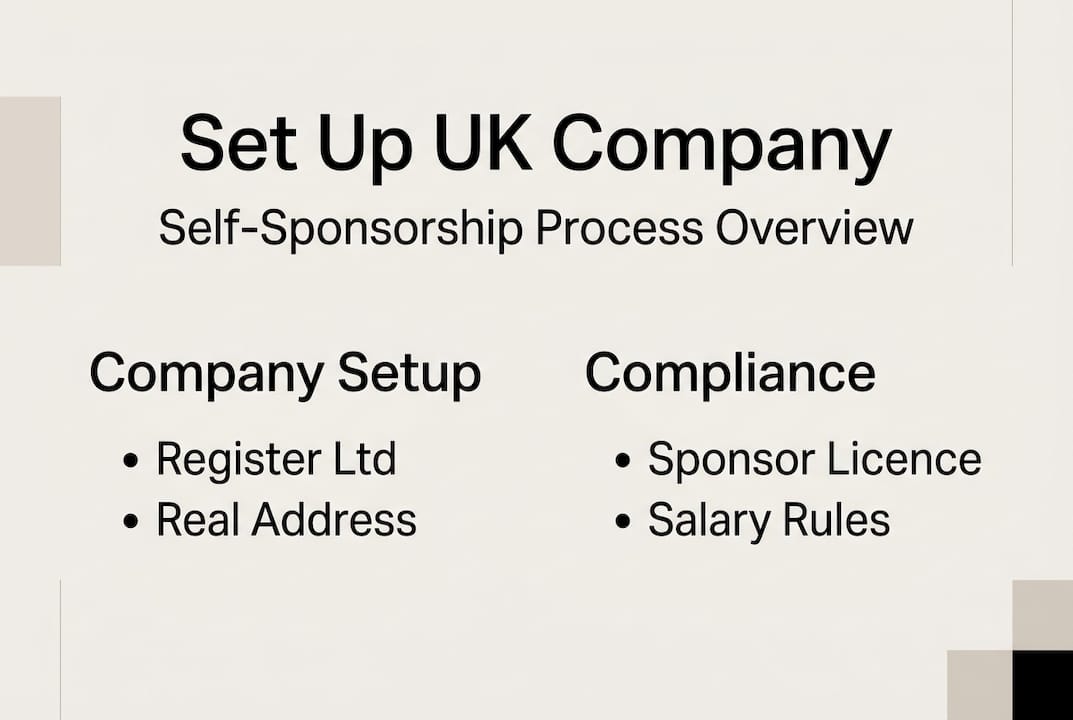
- Choose your company structure. For self-sponsorship, a private limited company (Ltd) is almost always the right choice. It gives you legal separation between personal and business finances and is the structure the Home Office expects to see.
- Register at Companies House. You can register online for £50. You will need a registered UK address, at least one director, and at least one shareholder. As a Turkish national, you can be both.
- Select the correct SIC code. Your Standard Industrial Classification (SIC) code must align with the nature of your business and, critically, with the SOC code of the role you intend to sponsor yourself into.
- Open a UK business bank account. This is non-negotiable. The Home Office expects to see real financial activity. Several challenger banks now offer accounts to non-resident directors, which makes this step more accessible than it once was.
- Register with HMRC. You must register for Corporation Tax within three months of starting to trade. If your turnover will exceed the VAT threshold, register for VAT too.
- Build your business infrastructure. This means a working website, a business email address, contracts, and a clear revenue model. These are not optional extras; they are evidence.
Here is a comparison of company types relevant to Turkish visa applicants:
| Company type | Suitable for self-sponsorship? | Notes |
|---|---|---|
| Private limited company (Ltd) | Yes | Preferred by Home Office |
| Sole trader | No | Cannot hold a sponsor licence |
| Partnership | Rarely | Complex; not recommended |
| Branch of overseas company | Sometimes | Requires additional evidence |
The salary requirements guide explains how your company’s financial position must support the salary you intend to pay yourself. Note that sponsor licence approval sits at only around 56%, which underlines why every step must be done properly.
Pro Tip: Use a business services provider that specialises in immigration compliance, not just general company formation. A generic accountant may register your company correctly but miss the immigration-specific details that the Home Office will look for.
Avoid using nominee directors, as the Home Office views this as a red flag. Ensure your registered address is a real, verifiable UK location, not a virtual mailbox with no substance behind it.

Ensuring your company is ‘genuine’ and compliant
Company registration alone is not enough. You must also demonstrate that your business and the job you are sponsoring yourself into are both legitimate.
A genuine vacancy means the role must exist because the business genuinely needs it, not simply because you need a visa. Your business plan should explain what the company does, how it generates revenue, and why your specific role is essential to its operation. The salary compliance rules also apply here: the salary must be commercially realistic for the role, not artificially inflated or deflated.
Evidence the Home Office typically expects includes:
- A detailed, credible business plan with financial projections
- A working company website with real content
- Signed contracts or letters of intent from clients or suppliers
- Bank statements showing trading activity
- Evidence of your qualifications and experience relevant to the role
- A job description that matches the SOC code precisely
Common pitfalls that lead to refusal:
- Creating a role that exists only on paper
- Choosing the wrong SOC code for your actual duties
- Failing to meet the genuine vacancy, SOC, and salary requirements simultaneously
- Submitting a business plan that is vague or lacks financial credibility
- Missing or inconsistent documentation
Only around 56% of sponsor licence applications are approved. That figure drops further when applicants submit without proper preparation. A strong compliance file is your single most effective tool against refusal.
Pro Tip: Start your compliance file on the day you register your company. Document every business decision, every client interaction, and every financial transaction. When the Home Office audits your licence, this file is your defence.
Applying for the sponsor licence and skilled worker visa
Once your company is prepared and compliant, you are ready to apply for the sponsor licence and, with a Certificate of Sponsorship, pursue your Skilled Worker visa.
Applying for the sponsor licence:
- Log in to the Sponsor Management System (SMS) on the Home Office website.
- Complete the online application, selecting the correct worker category.
- Pay the application fee (currently £536 for small sponsors).
- Submit supporting documents, including your business plan, bank statements, HMRC registration, and evidence of trading activity.
- Await the Home Office decision, which may include an unannounced compliance visit.
Once the licence is granted:
- Assign a Certificate of Sponsorship to yourself through the SMS.
- Ensure the CoS reflects the correct SOC code, salary, and job title.
- Submit your Skilled Worker visa application online, paying the visa fee and Immigration Health Surcharge.
Documents required for the visa application include:
- Valid passport
- Certificate of Sponsorship reference number
- Proof of English language at B1 to B2 level
- Evidence of £1,270 in maintenance funds held for 28 consecutive days
- Qualifications relevant to the role
The self-sponsorship application steps cover the full process in detail. Importantly, Skilled Worker visa approval reaches approximately 94% once a valid CoS is in place, which means your energy should be focused on the licence stage, not the visa stage.
Priority processing is available for an additional fee and can reduce the visa decision timeline to five working days. Standard processing typically takes three to eight weeks.
What most guides miss about UK self-sponsorship
Most articles about self-sponsorship focus on the mechanics: register a company, get a licence, apply for a visa. That is the skeleton, but it is not what separates successful applications from failed ones.
The Home Office is not looking for a company. It is looking for a business. There is a meaningful difference. A company is a legal entity. A business has customers, revenue, a credible plan, and a reason to exist. Turkish applicants who treat self-sponsorship as a visa mechanism rather than a genuine commercial venture are the ones who face refusal.
Start preparing your supporting documents before you even register the company. Your business plan, financial projections, and evidence of market demand should exist in draft form before Companies House ever sees your application. This sequencing matters because it forces you to think like a business owner, not a visa applicant.
The rarely discussed risk is underestimating the English language and sponsorship compliance advice around salary. Many applicants spend months perfecting their business plan and then stumble at the English test or discover their intended salary falls below the going rate. Check both of these early.
Engage a UK-based adviser with genuine immigration experience, not just a business consultant who has helped people register companies. The overlap between company law and immigration compliance is narrow, and you need someone who understands both.
Specialist support for your UK self-sponsorship journey
If you want to avoid costly errors and accelerate your UK journey, here is how our team supports Turkish professionals every day.
At metin.london, we work exclusively with Turkish-speaking professionals navigating the UK immigration system. We are regulated by the Immigration Advice Authority (IAA) at Level 1, Ref No. F202000206, which means you receive qualified, accountable advice at every stage.
From helping you understand self-sponsorship in detail to ensuring you meet the required salary rules, we handle the complexity so you can focus on building your business. Whether you are at the company formation stage or ready to submit your sponsor licence, our team is ready to guide you. Speak with our UK visa experts today and take the first step with confidence.
Frequently asked questions
What is the minimum investment required to set up a UK company for self-sponsorship?
There is no set investment minimum, but your company must demonstrate the funds to trade and pay the required salary. Maintenance funds of £1,270 must also be held for 28 consecutive days before your visa application.
Can I sponsor myself if my business is newly registered?
Yes, but a newly registered company must provide particularly strong evidence of a genuine vacancy and real business activities. Registration alone will not satisfy the Home Office without substantiated trading plans and documentation.
Do I need to pass an English test to apply for the skilled worker visa through my own company?
Yes. You must demonstrate English at B1 to B2 level, and from January 2026, the criteria become stricter, so it is worth preparing early.
How long does it take to get a sponsor licence and visa approval?
Sponsor licence decisions typically take several weeks, and the Skilled Worker visa is usually decided within three to eight weeks after a CoS is issued. With a valid CoS, the visa approval rate sits at approximately 94%.