TL;DR:
- There is no single child dependent visa route in the UK; eligibility depends on the parent’s immigration status.
- Families must meet strict criteria regarding age, dependency, and proof of relationship, finances, and accommodation.
- Applying successfully requires thorough documentation, clear explanations, and understanding of specific legal pathways and exceptions.
Many Turkish families assume there is one straightforward “child dependent visa UK” they can simply apply for. That assumption leads to delays, refusals, and real distress. In reality, no single child visa exists; the route your child uses depends entirely on your own immigration status in the UK. Whether you hold a skilled worker visa, a student visa, or settled status, your child’s application follows a different legal pathway. This guide explains every major route, eligibility condition, and document requirement so Turkish families and students can approach the process with confidence and clarity.
Table of Contents
- Understanding UK child dependent visa routes
- Core eligibility criteria for child dependants
- Financial and accommodation requirements explained
- Document checklist and application process
- What most families miss about child dependent visa success
- How we support your UK child dependent visa journey
- Frequently asked questions
Key Takeaways
| Point | Details |
|---|---|
| No single child visa | The UK routes for child dependants depend on the parent’s immigration status and visa type. |
| Strict eligibility rules | Children must meet age, dependency, and residency criteria for all main UK visa routes. |
| High financial thresholds | Family route sponsors face a high minimum income requirement, with lower set rates for work routes. |
| Evidence is critical | Visa refusals often happen because evidence does not clearly show dependency or suitable accommodation. |
| No special rules for Turkish families | Turkish families follow the same process and criteria as any other nationality for a UK child dependent visa. |
Understanding UK child dependent visa routes
With the confusion around visa types cleared, let’s break down the available child dependent visa routes. The UK does not operate a single catch-all visa for children. Instead, applications follow specific appendices depending on the parent’s immigration status: Appendix FM covers family routes, while Appendix Children governs work and study dependants. Understanding which appendix applies to your family is the single most important first step.
The two main routes work very differently in practice. Appendix FM applies when the sponsoring parent is a British citizen, settled resident, or holds refugee or humanitarian protection status. Appendix Children applies when the parent is in the UK on a work or study visa, such as a skilled worker or postgraduate student visa. You can explore the full scope of both pathways in our dependent visa UK guide.
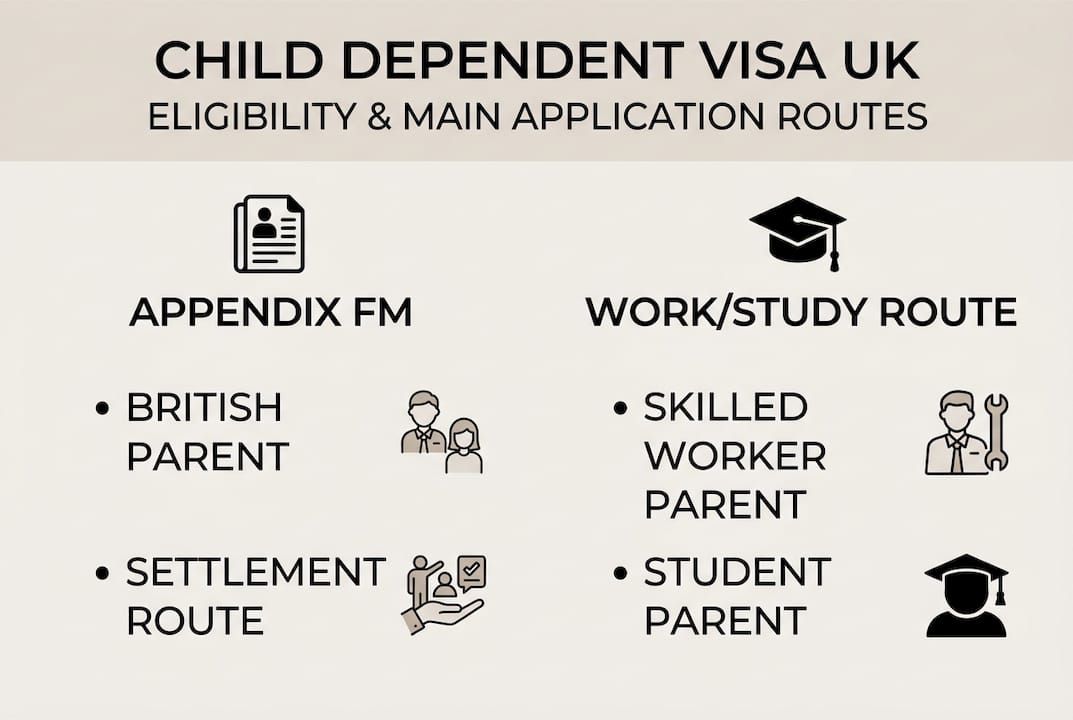
Here is a quick comparison of the two main routes:
| Feature | Appendix FM (family route) | Appendix Children (work/study route) |
|---|---|---|
| Parent’s status | Settled, British, refugee | Skilled worker, postgraduate student |
| Minimum income | £29,000 (no child add-on) | £315 first child, £200 each extra |
| Child age limit | Under 18 | Under 18 |
| Leave duration | Mirrors parent’s leave | Mirrors parent’s leave |
| Student dependants | Not applicable | Postgraduate and govt-sponsored only |
When deciding which route applies to your family, ask yourself:
- Is the sponsoring parent a British citizen or do they have indefinite leave to remain? Use Appendix FM.
- Is the parent on a skilled worker, health and care, or global talent visa? Use Appendix Children.
- Is the parent a student? Dependants are only permitted if the parent is studying at postgraduate level or is a government-sponsored student, a restriction tightened in 2024.
- Is the parent on a short-term or visitor visa? Children cannot apply as dependants in those cases.
Important: There are no Turkey-specific exceptions to these rules. Turkish families are assessed under exactly the same Immigration Rules as any other nationality. Focus on your evidence, not your passport.
If your family’s situation has changed recently, our guide on new dependent visa rules covers the 2024 and 2026 updates in detail, including which routes now carry tighter restrictions.
Core eligibility criteria for child dependants
Now that you know the available routes, see if your family meets the eligibility conditions. The official child visa guidance sets out the universal requirements clearly, but families often overlook some of the finer details that caseworkers scrutinise closely.
A child must meet all of the following core conditions to qualify:
- Under 18 at application, unmarried or not in a civil partnership, and financially and emotionally dependent on the sponsoring parent
- Living with the parent, or in full-time boarding education with the parent acting as primary carer
- Not leading an independent life, which means not working full-time, not living in a separate household by choice, and not financially self-sufficient
Beyond these universal conditions, certain special circumstances also apply. If only one parent is in the UK (sole responsibility cases), that parent must demonstrate they make all major decisions for the child’s upbringing, including schooling and healthcare. Children born of a previous relationship are eligible, but the non-resident parent’s consent may be required, particularly if there is a custody arrangement. You can review the updated eligibility rules to understand how recent changes affect complex family structures.
There are also important exceptions to the under-18 rule. A child who was previously granted leave as a dependant and is now 18 or older may still qualify, provided they remain fully dependent. Adopted children are eligible if the adoption is legally recognised in the UK. For dependency proof guidance, the Home Office expects evidence that is consistent, specific, and current, not just a brief statement.
Pro Tip: A well-structured cover letter that maps each piece of dependency evidence to the relevant Immigration Rule paragraph significantly improves approval rates. Do not assume a caseworker will connect the dots for you.
Financial and accommodation requirements explained
Once your family meets eligibility, it is vital to understand strict financial and living standards. Many refusals at this stage are entirely avoidable. The family visa financial rules are specific about both the threshold amounts and the evidence required to prove them.

Here is how the two main routes compare financially:
| Route | Income threshold | Child add-on |
|---|---|---|
| Appendix FM | £29,000 gross per year | No add-on for children |
| Appendix Children (work routes) | £315 for first child, £200 for each additional child | Added to sponsor’s base threshold |
For financial requirements in detail, income from employment, self-employment, or a combination of both can count. What does not count includes income from public funds, casual or undeclared work, or income earned outside the UK unless specified. Cash savings can supplement income shortfalls, but they must have been held for at least six months and the calculation formula differs by route.
To document accommodation correctly, follow these steps:
- Obtain a property inspection report from a qualified inspector confirming the property meets Health in Housing standards
- Show the property will not be overcrowded after the child arrives, using bedroom counts and occupant numbers
- Include a tenancy agreement or mortgage statement proving legal right to occupy the property
- Confirm no use of public funds is expected or required to maintain the accommodation
A common pitfall is submitting a payslip or bank statement without an explanation of how the figures meet the threshold. Another is providing an accommodation letter from a landlord without a proper inspection report, which Home Office caseworkers routinely reject.
Pro Tip: If you genuinely cannot meet the minimum income requirement, GEN.3.1 of Appendix FM allows caseworkers to apply financial rules with flexibility where the best interests of the child clearly demand it. However, the evidence supporting this argument must be strong and detailed, not merely a statement of hardship.
Document checklist and application process
With finances and eligibility established, the final step is assembling and submitting the correct documents. The application steps are carried out online, but the quality of your supporting evidence determines the outcome more than anything else.
Follow these steps to apply:
- Create or log into a UKVI account and select the correct child dependant application form
- Complete all sections accurately, including the child’s personal details and the sponsor’s immigration reference
- Pay the application fee and the Immigration Health Surcharge for the full visa duration
- Upload all supporting documents in the correct format before submitting
- Book and attend a biometric appointment at a Visa Application Centre in Turkey
- Wait for a decision, which is typically issued within several weeks depending on the route
The key documents required include:
- Birth certificate or adoption certificate proving the relationship to the sponsoring parent
- Current passport for the child and copies of the sponsor’s passport and visa
- Parental consent letter if both parents are not travelling to the UK together
- Financial evidence: payslips, P60, bank statements, or employer letters
- Accommodation evidence: inspection report guidance and tenancy or ownership documents
- Tuberculosis (TB) test certificate from an approved clinic, required for applicants from Turkey
Caseworker reality: A significant proportion of child dependent visa refusals are caused not by genuine ineligibility, but by incomplete documents, unexplained gaps in evidence, or mismatched financial figures. A thorough cover letter cross-referencing every document to every requirement is one of the most effective tools you have.
What most families miss about child dependent visa success
Most families focus heavily on whether they technically qualify and forget that the caseworker only sees what is on the page in front of them. Refusals are common when financial or dependency proof is present but not clearly explained or mapped to the relevant rule.
One of the most misunderstood tools is GEN.3.1. This provision allows a caseworker to flex the financial rules where the best interests of the child are clearly and compellingly evidenced. However, families rarely present this evidence effectively. Simply saying a child needs to be with their parent is not enough. You need medical reports, school records, psychological assessments, or other concrete material that makes the child’s welfare case undeniable.
Turkish families sometimes assume their application will face extra scrutiny because of nationality. Our experience shows that nationality is not the deciding factor. What matters is the strength, clarity, and completeness of your in-depth family visa rules documentation. Think like a caseworker: for every requirement in the Immigration Rules, your evidence bundle should have a clear, labelled document with a page reference in your cover letter. That habit alone separates successful applications from refusals.
How we support your UK child dependent visa journey
Navigating the child dependent visa process is genuinely complex, especially when your family’s circumstances involve mixed visa types, sole responsibility, or recent rule changes. At UK Visa Assistance, regulated by the IAA at Level 1 (Ref No. F202000206), we provide hands-on expert support tailored to Turkish families and students.
Our team covers everything from assessing which route applies to your family, to preparing your full evidence bundle and cover letter. We also offer specialist property inspection services that satisfy Home Office accommodation requirements. Explore our full dependent visa guide or review the financial requirements breakdown to get started. When you are ready for personal advice, our consultants are here to guide you.
Frequently asked questions
Can a child over 18 still qualify as a dependant in the UK?
Yes, but only if the child was previously granted as a dependant and continues to be financially and emotionally dependent on the sponsoring parent.
Do all student and skilled worker visa holders qualify to sponsor child dependants?
Not always. Student dependants are restricted to postgraduate and government-sponsored students, and some work visa categories do not permit dependants at all.
What happens if you cannot meet the minimum income requirement?
You may still qualify under exceptional child welfare grounds through GEN.3.1, but you must provide strong welfare evidence demonstrating the child’s best interests clearly outweigh the financial shortfall.
Is there any special rule for Turkish applicants under the child dependent visa route?
No. No Turkey-specific rules apply; Turkish families are assessed under the same Immigration Rules as all other nationalities.
How long does a UK child dependent visa take to process?
Processing typically takes several weeks, depending on the route and whether all documents are complete and clearly presented at the time of application.