The UK continues to welcome international talent with open arms, and Turkish professionals are finding unprecedented opportunities across multiple sectors. Despite common misconceptions about restrictive immigration policies, the UK maintains a strong economy and actively seeks skilled workers from abroad. This comprehensive guide walks you through essential visa types, job market insights, application procedures, and pathways from student to professional status, equipping you with everything needed to launch your UK career successfully.
Table of Contents
- Why The UK Is A Prime Work Destination For Turkish Professionals
- Understanding UK Work Visa Options And Requirements In 2026
- Navigating The UK Job Application Process As A Turkish Citizen
- Switching From A UK Student Visa To A Work Visa And Career Prospects
- Explore Visa And Recruitment Services Tailored For Turkish Professionals
Key takeaways
| Point | Details |
|---|---|
| Strong economy and demand | The UK offers high living standards with particular demand in IT, finance, healthcare, and STEM sectors. |
| Sponsorship requirement | Most work visas require a job offer and Certificate of Sponsorship from a licensed UK employer. |
| Processing timelines | Visa applications typically take 3 to 8 weeks for decision, depending on visa category and application volume. |
| Student pathway | International students can transition from study visas to skilled worker visas after graduation. |
| Application steps | The process involves CV preparation, interviews, job offers, sponsorship certificates, and online visa submission. |
Why the UK is a prime work destination for Turkish professionals
The United Kingdom stands as one of Europe’s most attractive employment markets for international professionals. The UK is a preferred work destination due to its strong economy, high living standards, and international job opportunities that continue expanding in 2026. Turkish professionals benefit from a robust job market where skills are valued over nationality, and employers actively recruit global talent to fill critical gaps.
Several sectors demonstrate particularly strong demand for Turkish workers:
- Information technology and software development
- Financial services and fintech
- Healthcare and medical research
- Engineering and construction
- Hospitality and culinary arts
The multicultural environment across major UK cities creates a welcoming atmosphere for foreign professionals. London, Manchester, Birmingham, and Edinburgh host thriving international communities where Turkish professionals can network, share experiences, and build careers without facing isolation. Many companies in these cities have established diversity programmes specifically designed to attract and retain talent from outside the UK.
Employers in STEM fields especially recognise the value Turkish professionals bring. The UK education system produces fewer STEM graduates than the market demands, creating opportunities for qualified international candidates. Companies in technology hubs like Cambridge and the Manchester digital corridor regularly sponsor skilled worker jobs for Turkish applicants when they cannot fill positions domestically.
Pro Tip: Research UK companies with existing Turkish employees or partnerships in Turkey, as they often have streamlined sponsorship processes and cultural understanding that smooths your transition.
The positive employer attitude towards sponsorship has strengthened considerably. When talent shortages exist, UK businesses view sponsorship not as a burden but as a necessary investment in their workforce. This shift in perspective means Turkish professionals with in-demand skills face fewer barriers than ever before when seeking UK employment.
Understanding UK work visa options and requirements in 2026
Navigating the UK visa system requires understanding the fundamental categories and their specific requirements. UK work visas are divided into two main groups: Long-Term Visas Requiring a Sponsor and Temporary Work Visas. Each category serves different purposes and comes with distinct eligibility criteria that Turkish applicants must meet.
Long-term sponsored visas form the backbone of the UK work immigration system. The Skilled Worker visa represents the most common route, requiring a job offer from a licensed sponsor in an eligible occupation. Your employer must provide a Certificate of Sponsorship, a digital document containing details about your role, salary, and sponsorship. The position must meet minimum salary thresholds, typically £38,700 annually or the going rate for the occupation, whichever is higher.
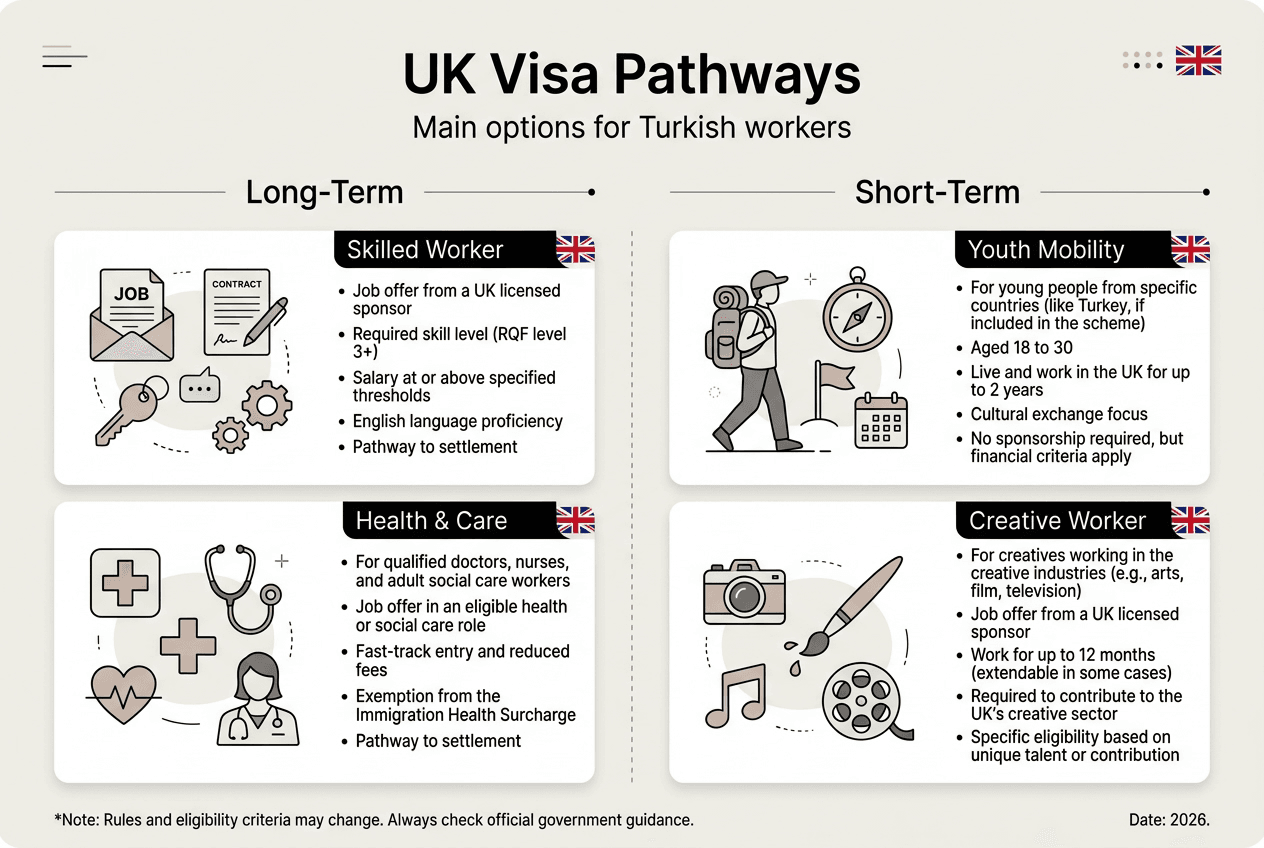
The UK skilled worker visa guide for Turkish professionals details additional pathways including the Health and Care Worker visa for medical professionals, which offers reduced fees and faster processing. Scale-up visas allow employment with fast-growing companies, whilst Global Talent visas recognise exceptional individuals in science, humanities, engineering, medicine, digital technology, and arts.
Temporary work visas serve shorter-term needs. The Youth Mobility Scheme, Creative Worker visa, and Charity Worker visa each address specific situations. These typically allow stays of 12 to 24 months and may not lead directly to settlement, making them less suitable for Turkish professionals seeking permanent career moves.
| Visa Type | Duration | Sponsorship Required | Path to Settlement |
|---|---|---|---|
| Skilled Worker | Up to 5 years | Yes | Yes, after 5 years |
| Health and Care Worker | Up to 5 years | Yes | Yes, after 5 years |
| Global Talent | Up to 5 years | No | Yes, after 3 years |
| Graduate | 2-3 years | No | No direct path |
The average processing time for UK work visa applications is between 3 to 8 weeks. Priority services can reduce this to 5 working days for an additional fee. Turkish applicants submit applications through the UK government’s online portal, providing biometric information at a visa application centre in Turkey. Required documents typically include passport, Certificate of Sponsorship reference number, proof of English language ability, and evidence of maintenance funds.
Pro Tip: Begin gathering documents months before your planned application date, as obtaining certified translations and meeting financial requirements takes longer than most applicants expect.
Some Turkish entrepreneurs explore self-sponsorship visa options for the UK, establishing a UK company that then sponsors them as an employee. This route requires careful planning, legal compliance, and sufficient capital, but offers independence for those with business ambitions alongside employment goals.
Navigating the UK job application process as a Turkish citizen
Securing UK employment as a Turkish professional involves strategic preparation and understanding employer expectations. The job application process typically involves finding job openings, preparing a UK-style CV and cover letter, attending screening calls and interviews, receiving a job offer, issuance of the Certificate of Sponsorship, and submitting a visa application. Each stage requires attention to detail and cultural awareness of UK recruitment practices.

Your CV must follow British conventions, which differ significantly from Turkish formats. UK CVs typically span two pages maximum, focus on achievements rather than duties, and avoid personal information like photographs, marital status, or age. Structure your CV with a professional summary, key skills, work experience in reverse chronological order, education, and relevant certifications. Quantify achievements wherever possible, using metrics that demonstrate impact.
Follow these steps to maximise your application success:
- Identify companies with sponsor licences using the UK government’s public register of licensed sponsors.
- Tailor each application to the specific role, incorporating keywords from the job description into your CV and cover letter.
- Prepare for competency-based interviews where you provide specific examples demonstrating required skills.
- Research typical UK interview questions and practise responses that showcase your experience and cultural fit.
- Follow up professionally after interviews, expressing continued interest whilst respecting the employer’s timeline.
- Negotiate salary and benefits before accepting, ensuring the offer meets visa salary thresholds.
Finding sponsors requires targeting companies with established sponsorship programmes. Large corporations, technology firms, healthcare organisations, and engineering companies regularly sponsor international workers. Finding a job in the UK as a foreigner becomes easier when you focus on sectors experiencing skills shortages, where employers actively seek international candidates.
Networking plays a crucial role in UK job searches. LinkedIn remains the primary professional networking platform, and Turkish professionals should optimise their profiles with UK-focused keywords, engage with industry content, and connect with recruiters specialising in their field. Attending virtual industry events and joining professional associations increases visibility and demonstrates commitment to your sector.
Pro Tip: When employers ask about sponsorship needs during interviews, frame it positively by emphasising your unique skills and how sponsorship represents a worthwhile investment in talent they cannot easily find domestically.
The Certificate of Sponsorship arrives after you accept a job offer and the employer completes their sponsorship duties. This digital document contains a unique reference number you use when applying for your visa. Employers typically issue it within days of finalising employment terms, though some larger organisations have internal approval processes that extend the timeline. Increasing your chances of finding a sponsor involves demonstrating exceptional skills, showing cultural adaptability, and targeting roles where Turkish language abilities or market knowledge add strategic value.
Switching from a UK student visa to a work visa and career prospects
Turkish students studying in the UK enjoy structured pathways to convert their educational experience into professional careers. All international students who want to study in the UK for more than six months must apply for a UK Student visa, previously known as the Tier 4 visa. This visa permits part-time work during studies, providing valuable UK employment experience that strengthens future job applications.
The Graduate visa, introduced to retain international talent, allows students who complete eligible UK degrees to work or seek employment for two years after graduation, extending to three years for doctoral graduates. This visa requires no sponsorship and permits work in any role at any skill level, giving Turkish graduates flexibility to explore career options, gain experience, and secure sponsored positions.
Transitioning from Graduate to Skilled Worker visa involves finding an employer willing to sponsor you before your Graduate visa expires. The process mirrors standard Skilled Worker applications, requiring a job offer meeting salary and skill thresholds. Many Turkish graduates successfully make this switch by:
- Leveraging internships and part-time work completed during studies into full-time sponsored roles
- Networking with alumni and university career services to identify sponsoring employers
- Targeting graduate schemes at large companies with established sponsorship programmes
- Demonstrating UK work experience and cultural integration that reduces employer perceived risk
Sectors welcoming Turkish graduates show particular strength in areas aligning with UK university strengths:
| Sector | Typical Roles | Sponsorship Likelihood |
|---|---|---|
| Technology | Software engineer, data analyst, cybersecurity specialist | Very High |
| Finance | Financial analyst, accountant, risk manager | High |
| Healthcare | Junior doctor, nurse, medical researcher | Very High |
| Engineering | Civil engineer, mechanical engineer, project manager | High |
| Consulting | Business analyst, management consultant | Moderate |
UK universities maintain strong industry connections, and Turkish students should actively engage with career services, attend employer presentations, and participate in placement programmes. These activities not only build skills but also create relationships with potential sponsors who value candidates already familiar with their organisation and culture.
The switch from UK student visa to skilled worker visa requires careful timing and preparation. You can apply to switch whilst in the UK, avoiding the need to return to Turkey between visas. Start your job search at least six months before your current visa expires, allowing time for applications, interviews, and visa processing without gaps in your legal status.
Study-to-work pathways offer Turkish professionals significant advantages. UK degrees carry international recognition, English language proficiency developed through study meets visa requirements without additional testing, and the cultural adaptation period occurs during studies rather than after employment begins. These factors combine to make the student route an attractive option for younger Turkish professionals planning long-term UK careers.
Explore visa and recruitment services tailored for Turkish professionals
Navigating UK immigration and employment independently can feel overwhelming, particularly when balancing applications with current responsibilities in Turkey. Professional guidance streamlines the process, reduces errors that delay applications, and connects you with opportunities matching your skills and career goals.
UK Visa Assistance specialises in supporting Turkish professionals through every stage of their UK journey. Our services, regulated by the Immigration Advice Authority, cover comprehensive visa categories including Skilled Worker, Health and Care Worker, Global Talent, and innovative self-sponsorship visa pathways. We provide expert immigration advice, application support, and recruitment assistance that matches Turkish talent with UK employers actively seeking international professionals. Our team understands the unique challenges Turkish applicants face and offers tailored solutions that address language, documentation, and cultural considerations. Whether you need visa guidance, job matching, or end-to-end support, we transform complex processes into manageable steps towards your UK career.
FAQ
Can Turkish citizens apply for UK work visas without a job offer?
For most work visas in the UK, you need a job offer first, then you apply for the visa. The Skilled Worker visa, Health and Care Worker visa, and similar routes all require sponsorship from a licensed UK employer before you can submit your application. Limited exceptions exist for exceptional talent through the Global Talent visa or entrepreneurs establishing UK businesses, but these represent specialised pathways with stringent eligibility criteria beyond standard employment.
How long does it usually take to get a UK work visa decision in 2026?
The average processing time for UK work visa applications is between 3 to 8 weeks from the date you submit your biometric information. Processing times vary based on visa type, application volume, and whether you use priority services. Standard applications typically receive decisions within six weeks, whilst priority services can reduce this to five working days for an additional fee. Super priority services, where available, may deliver decisions within 24 hours.
What sectors have the highest demand for Turkish professionals in the UK?
There is strong demand for Turkish professionals in fields like IT, software development, data science, finance, healthcare, game development, logistics, hospitality and construction. Technology roles consistently appear on shortage occupation lists, whilst healthcare faces ongoing staffing challenges that create opportunities for qualified medical professionals. Engineering and construction sectors value Turkish professionals’ technical expertise, particularly in infrastructure projects. Finance and professional services seek multilingual candidates who can support international business development.
Do Turkish students need to return home after completing UK degrees?
No, Turkish students can remain in the UK through the Graduate visa, which permits two years of post-study work without sponsorship requirements. During this period, you can seek employment, work in any role, or establish your career foundation before transitioning to a sponsored visa. Doctoral graduates receive three years under the Graduate route. This flexibility allows you to convert your UK education into professional experience and secure sponsored employment without returning to Turkey between visas.
What English language requirements apply to Turkish work visa applicants?
Most UK work visas require English language proficiency at CEFR Level B1 or higher, demonstrated through approved tests like IELTS or by holding a degree taught in English. Turkish applicants who studied at UK universities automatically meet this requirement. Others must take approved English language tests and achieve minimum scores in reading, writing, speaking, and listening. Some visa routes, particularly for highly skilled roles, may accept alternative evidence of English proficiency, but standardised testing remains the most common pathway for Turkish professionals.
Recommended
- UK skilled worker visa guide for Turkish professionals 2026
- Skilled worker jobs in the UK for Turkish applicants 2026
- Finding a Job in the UK: A Guide for Foreigners – METIN.LONDON
- Haberler – METIN.LONDON
- The UK Post – Study-Work Visa Restrictions – xpath.global
- How to attract top security talent in the UK in 2026|SJB