TL;DR:
- Most Home Office refusals can be challenged successfully through appeals and legal processes.
- The UK tribunal system has two main tiers: First-tier handles initial appeals, Upper Tribunal reviews legal errors.
- Successful appeals depend heavily on clear evidence, precise legal grounds, and professional support.
A Home Office refusal does not have to be the end of your immigration journey. 45% of tribunal-reviewed asylum refusals are overturned on appeal, pointing to serious decision-making errors that cost applicants months or years of uncertainty. For Turkish-speaking applicants, who already face complex visa landscapes and language barriers, understanding how immigration tribunals work is genuinely life-changing knowledge. Whether you are appealing a family visa refusal, a skilled worker rejection, or an asylum decision, this guide walks you through every stage of the process clearly and practically.
Table of Contents
- Understanding UK immigration tribunals
- Who can appeal and what decisions qualify?
- Lodging an appeal: Process, deadlines and fees
- From initial appeal to upper tribunal and judicial review
- Outcomes, backlogs and factors affecting success
- A fresh perspective on tribunal appeals
- Expert support for your UK immigration appeal
- Frequently asked questions
Key Takeaways
| Point | Details |
|---|---|
| Tribunals give independent review | UK immigration tribunals offer a second look at Home Office decisions, focussing on fairness and legal accuracy. |
| Appeal rights vary by visa | Not all UK visa refusals can be appealed, with human rights and asylum claims more likely to qualify. |
| Evidence and deadlines matter | Success depends on submitting strong evidence within strict time limits, so preparation is critical. |
| Legal advice improves outcomes | Having expert support or representation makes tribunal appeals far more likely to succeed. |
| Delays are common | Backlogs in UK immigration tribunals mean many cases take over a year to resolve. |
Understanding UK immigration tribunals
Most people think of immigration appeals as one single court hearing. In reality, the UK has a layered tribunal structure, and knowing which tier handles your case is the first step to building a strong appeal strategy.
The two-tier system
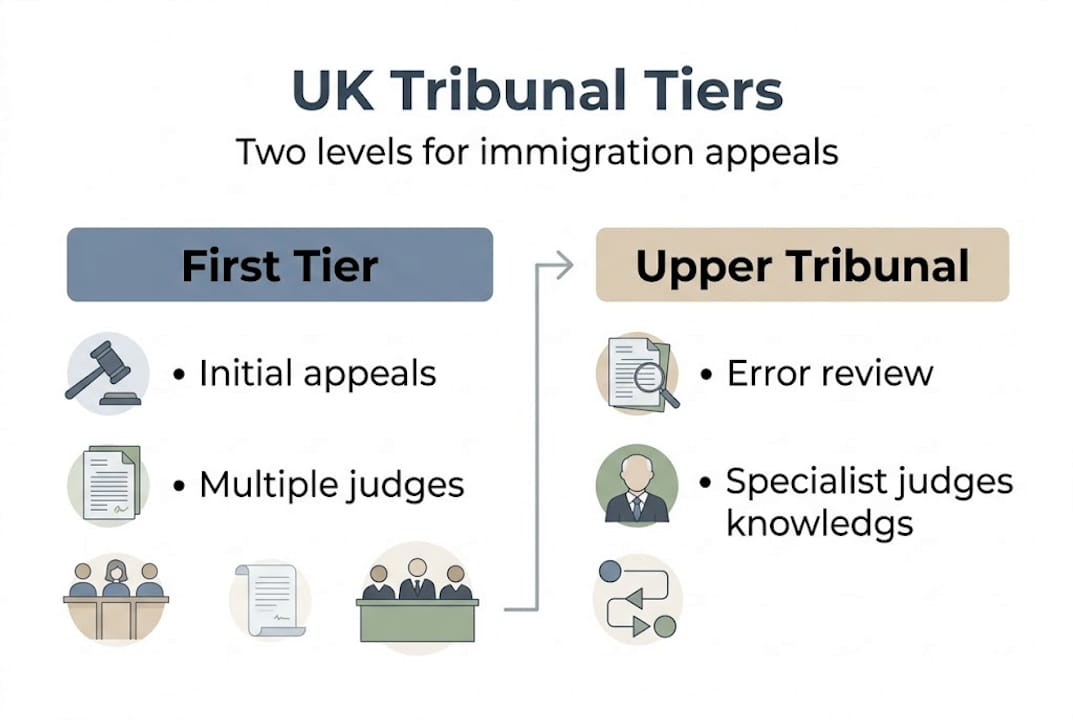
The First-tier Tribunal (Immigration and Asylum Chamber) handles initial appeals against Home Office decisions on immigration, asylum, permission to stay, deportation, and entry clearance. It is the starting point for almost every appeal in England, Scotland, and Wales. The tribunal sits independently of the Home Office, meaning the judge reviewing your case has no connection to the official who refused your application.
If the First-tier Tribunal rules against you, you are not necessarily out of options. The Upper Tribunal (Immigration and Asylum Chamber) hears appeals from the First-tier on errors of law and also handles judicial reviews of public body decisions in immigration and asylum cases. This is not a rehearing of the facts. The Upper Tribunal asks a specific question: did the First-tier Tribunal make a legal mistake?
Key differences at a glance
| Tribunal tier | What it reviews | Who hears it |
|---|---|---|
| First-tier Tribunal | Home Office decisions | Immigration judge |
| Upper Tribunal | Errors of law from First-tier | Senior immigration judge |
| Judicial review | Unlawful public body decisions | Upper Tribunal or High Court |
Understanding this distinction matters enormously. Many Turkish applicants prepare a brilliant factual case for an Upper Tribunal application, when actually what is required is a focused legal argument about whether the judge below applied the law correctly.
Why independence matters
The tribunal system was designed precisely because governments make mistakes. A tribunal judge is not answerable to the Home Office, and that separation creates the conditions for genuine review. For Turkish applicants navigating skilled worker job rejections or family visa refusals, this independence is the core reason appeals can and do succeed.
Pro Tip: Before assuming your case is hopeless, read the refusal letter carefully. Tribunals frequently overturn decisions where the Home Office applied the wrong legal test or ignored compelling evidence, not just where new facts emerge.
Preparing for a tribunal hearing also benefits from understanding what judges expect to see. Our immigration interview guide covers how to present your story clearly and credibly, which translates directly to tribunal evidence preparation.
Who can appeal and what decisions qualify?
Not every visa refusal carries the right to a tribunal appeal. This is one of the most misunderstood areas of UK immigration law, and getting it wrong means missing deadlines and losing options.
Decisions that carry full appeal rights
Not all visa refusals have appeal rights. Typically, full appeal rights apply to asylum and protection claims, human rights claims (for example, Article 8 family life), revocation of leave to remain, deportation orders, and EU Settlement Scheme refusals. These categories carry the strongest protections because the consequences of an error are most severe.
By contrast, visitor visas, most student visas, and standard work visas usually only permit an administrative review rather than a full tribunal appeal. Administrative review is handled internally by the Home Office, which checks whether a case-worker error occurred. It is quicker and cheaper, but it does not carry the same independent scrutiny as a tribunal.
Common appeal-eligible decisions for Turkish applicants
- Refusal of asylum or humanitarian protection
- Refusal of a human rights claim (Articles 3 and 8 of the European Convention on Human Rights are most common)
- Deportation orders following criminal conviction
- Revocation of indefinite leave to remain
- Refusal under the EU Settlement Scheme
- Certain family visa refusals where human rights grounds apply
Administrative review vs full appeal
| Decision type | Route available |
|---|---|
| Asylum refusal | Full tribunal appeal |
| Human rights refusal | Full tribunal appeal |
| Visitor visa refusal | Administrative review only |
| Student visa refusal (most cases) | Administrative review only |
| Skilled Worker visa refusal | Administrative review only |
| EU Settlement Scheme refusal | Full tribunal appeal |
If you are unsure which route applies to your refusal, check the refusal letter. UK law requires the Home Office to state what review rights you have and within what timeframe.
Pro Tip: Even when only administrative review is available, a strong, well-evidenced review request can succeed. Do not dismiss it as a rubber stamp. Many visa refusals are reversed at this stage when the original decision-maker clearly overlooked documents.
Knowing your route also affects how you prepare. Applicants facing tribunal appeals for family visas should read our detailed guidance on renewing your UK visa to understand supporting documents that strengthen both renewal applications and appeals.
Lodging an appeal: Process, deadlines and fees
Once you know you have appeal rights, speed is everything. Missing a deadline in immigration law is catastrophic, and tribunals have very limited discretion to accept late appeals.
Step-by-step appeal process
- Receive the refusal letter. Your deadline starts from the date stated in this letter, not from when you read it.
- Identify your appeal window. You have 14 days if you are in the UK, or 28 days if you are outside the UK.
- Complete Form IAFT-1. This is the standard form for lodging an appeal with the First-tier Tribunal.
- Pay the fee. As set out in official guidance, the fee is £80 for a paper-based decision and £140 for an oral hearing.
- Submit your appeal bundle. This includes your grounds of appeal, supporting evidence, and any witness statements.
- Await a hearing date. Given current backlogs, this may take many months.
Fee structure at a glance
| Hearing type | Fee |
|---|---|
| Paper determination | £80 |
| Oral hearing | £140 |
| Fee exemption (asylum) | £0 |
Asylum applicants are exempt from tribunal fees, which removes one barrier to challenging a refusal. For other categories, the relatively modest fee does not reflect the true cost of the process once you factor in legal representation and evidence gathering.
What to include in your appeal bundle
Your appeal grounds must clearly explain why the Home Office decision was wrong in law or wrong on the facts. Vague grounds such as “I disagree with the decision” are insufficient. Strong grounds reference specific paragraphs of the refusal letter and identify the legal test that was allegedly misapplied.
Evidence matters enormously at this stage. Witness statements from family members, letters from employers, medical reports, and country condition evidence in asylum cases all strengthen an appeal. If you gather new evidence after the initial refusal, you can generally submit it, but it must be relevant to the grounds you have raised.

Pro Tip: Request an oral hearing rather than a paper determination wherever possible. Oral hearings allow you or your representative to respond to the judge’s concerns directly, and success rates are historically higher than paper-only decisions.
From initial appeal to upper tribunal and judicial review
If the First-tier Tribunal dismisses your appeal, the journey does not end there. Two further routes exist, though both are more technically demanding.
Applying to the Upper Tribunal
The process for taking a case to the Upper Tribunal is a two-stage one. First, you apply to the First-tier Tribunal itself for permission to appeal. If that is refused, you apply directly to the Upper Tribunal.
To succeed at this stage, you must identify a genuine error of law. This means showing that the judge made a mistake in how they applied the law, not simply that you disagree with their conclusion. Common errors of law include failing to consider material evidence, applying the wrong legal test, or giving inadequate reasons for a decision.
According to MSD Solicitors’ tribunal guide, there is currently no fee to apply for permission to appeal to the Upper Tribunal, making it an accessible route despite its technical demands.
Judicial review
Judicial review is a different and more powerful tool. It challenges the lawfulness of a public body’s decision, not just whether it was wrong on the facts.
“Judicial review is not about whether the decision was the right one. It asks whether it was made lawfully, following proper process and within the boundaries of the law.”
Key facts about judicial review in immigration cases:
- You must apply within 3 months of the decision being challenged, though courts encourage much earlier filing.
- The initial fee for applying is £174, with a further fee of £874 if the case proceeds to a full hearing.
- You must first exhaust other available routes before judicial review will usually be considered.
- The UTIAC handles judicial review for most immigration and asylum decisions, keeping specialist expertise within the tribunal system.
Judicial review is commonly used where the Home Office has acted outside its powers entirely, for example by failing to apply a published policy or by making a decision that breaches a legitimate expectation.
“The higher the tribunal tier, the more precise your legal argument must be. At Upper Tribunal level, a compelling personal story is not enough on its own. You need identifiable legal error.”
Outcomes, backlogs and factors affecting success
Understanding the odds before you appeal helps you prepare realistically and make strategic decisions about your case.
Current tribunal statistics
The most recent tribunal statistics for October to December 2025 are sobering. The First-tier Tribunal received 32,000 new cases in that quarter alone, a 48% increase year on year. Disposals reached 14,000, but the open caseload now stands at 139,000, representing an 86% increase. The mean clearance time is 58 weeks.
The system is under enormous strain. For Turkish applicants, this means planning your timeline carefully and understanding that your appeal may not be heard for well over a year after submission.
Success rates by category
- Asylum and protection cases: 36% of determined cases allowed
- Human rights cases: 42% of determined cases allowed
- Overall: Outcomes vary significantly by case quality and legal representation
These figures confirm that a substantial proportion of appeals succeed, which challenges any assumption that pursuing a tribunal appeal is futile.
What actually drives success?
- Quality of evidence: Cases with well-organised, credible documentary evidence consistently outperform those without.
- Legal representation: As Free Movement reports, legal representation significantly improves outcomes, yet legal aid remains difficult to access.
- Strength of grounds: Precise, focused grounds of appeal are more persuasive than lengthy, unfocused submissions.
- Witness evidence: Credible oral testimony at an oral hearing can be decisive.
Pro Tip: Do not wait until your hearing date to gather evidence. Start building your bundle the moment you receive your refusal. Country condition reports, medical evidence, and witness statements all take time to obtain and translate where necessary.
Learning about visa assistance benefits can also help you understand how professional support changes outcomes in complex cases.
A fresh perspective on tribunal appeals
After working with Turkish-speaking applicants through the tribunal process, one pattern stands out above all others: applicants who treat a refusal as a temporary setback rather than a final verdict consistently achieve better outcomes than those who approach the system with resignation.
The Law Society has criticised government proposals to replace the First-tier Tribunal with a lay decision-making body, warning that this would undermine fairness for applicants. That debate reflects a broader truth: the tribunal system, for all its delays and pressures, currently offers genuine independent scrutiny of Home Office decisions, and Home Office error rates are persistently high.
What most applicants do not realise is that a well-prepared appeal serves two functions. It challenges the specific decision, but it also creates a formal record of your case history. Even if an appeal at First-tier level is unsuccessful, a carefully argued submission lays the groundwork for any Upper Tribunal application that follows.
The shortage of legal aid is real, but it does not mean going unrepresented is inevitable. Regulated advisers operating under the Immigration Advice Authority offer regulated, expert support at a fraction of barrister costs. Accessing the value of legal representation early in the process changes the trajectory of an appeal significantly.
Expert support for your UK immigration appeal
Receiving a Home Office refusal is stressful, but you do not have to face the tribunal process alone.
At UK Visa Assistance, regulated by the Immigration Advice Authority (IAA Level 1, Ref No. F202000206), we support Turkish-speaking clients through every stage of the immigration appeals process. From preparing your grounds of appeal to building a strong evidence bundle, our team understands both the legal framework and the practical pressures you face. Whether you need visa assistance for immigration appeals, are considering a self-sponsorship visa as an alternative route, or simply want to understand your options, explore our full range of UK visa services to take the next step with confidence.
Frequently asked questions
How long does an immigration tribunal appeal take for Turkish applicants?
Most immigration appeals average 58 weeks to clear, driven by record backlogs and high Home Office withdrawal rates that further clog the system.
Can you appeal a UK visitor or student visa refusal?
Visitor and student visa refusals generally carry only administrative review rights, not a full independent tribunal appeal, so you must challenge the decision through the Home Office itself.
What form and fee are needed for a UK immigration appeal?
You must submit Form IAFT-1 with a fee of £80 for a paper determination or £140 for an oral hearing before the tribunal.
Is legal representation necessary for tribunal success?
Legal representation significantly improves appeal outcomes, particularly in complex cases involving human rights or asylum grounds, where legal aid is increasingly difficult to obtain.
What happens after a First-tier Tribunal appeal fails?
You may apply to the Upper Tribunal for permission based on an identified error of law, or pursue judicial review through the Upper Tribunal for decisions that were made unlawfully.